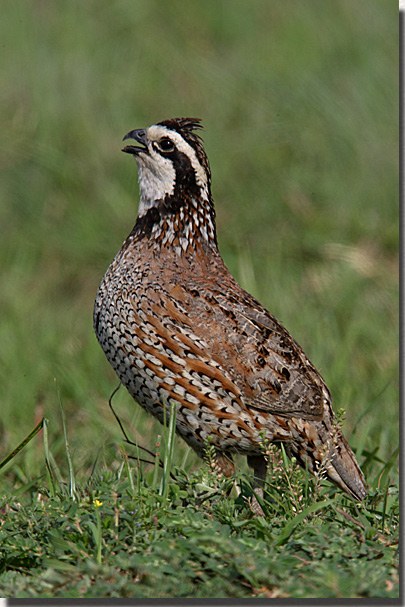
Bobwhite Quail
Colinus virginianus
- Habitat
- Grassy or brushy field edges, open pine woodland, and farmland with scattered dense cover
- Size
- 9.5-10.5 in
- Lifespan
- Very short-lived on average, with fewer than 20% surviving their first year; the oldest banded individual on record was 6 years, 5 months old.
- Diet
- Seeds, waste grain, and legumes as adults; insects make up much of the diet for young chicks
About the Bobwhite Quail
The Northern Bobwhite, commonly called the Bobwhite Quail, is a chunky, chicken-like ground bird with short rounded wings, a stubby tail, and a build suited to explosive, whirring takeoffs when flushed. Males show a bold white throat and eyebrow stripe outlined in black against a mottled reddish-brown, black, and white body; females wear a buffier version of the same pattern with less contrast, and both sexes are heavily camouflaged against dry grass and leaf litter when standing still.
It occurs across much of the eastern two-thirds of Oklahoma in a mix of grassland and shrubby cover, needing both bare ground for moving about and dense herbaceous vegetation for nesting and escape from predators and weather. Once abundant statewide and a mainstay of American upland game hunting, its numbers have fallen sharply over recent decades as intensive agriculture, fescue monocultures, and fire suppression have eliminated much of the brushy, early-successional habitat it depends on; the decline has been documented across nearly its entire range, not just in Oklahoma.
Bobwhites forage on the ground, scratching through leaf litter and low vegetation in loose groups. Diet shifts with age and season: insects are critical protein for chicks in their first weeks of rapid growth, while adults rely more heavily on seeds, grain, and legumes such as partridge pea the rest of the year. Coveys typically forage together within a fairly small home range, rarely straying far from good cover.
One of the most distinctive Bobwhite behaviors is covey roosting: at night, birds form a tight circle on the ground facing outward, tails toward the center, which helps them detect an approaching predator from any direction and conserve body heat on cold nights. Males give the familiar rising 'bob-WHITE' whistle that names the species, typically from an elevated perch during the breeding season. High natural mortality from predation, weather, and habitat loss is offset by prolific breeding, with large clutches of a dozen or more eggs and sometimes multiple nesting attempts in a single season, a reproductive strategy suited to a species that rarely lives more than a couple of years. Both parents can incubate and raise a brood independently, an unusual arrangement among game birds that allows a pair to potentially raise two broods in a single summer if conditions allow, further helping the population absorb heavy annual losses.
Frequently asked questions
Why is the Bobwhite population declining?
Loss of brushy, early-successional grassland habitat to intensive farming and fire suppression is the leading cause across most of its range.
What does the 'bobwhite' call mean?
It's the male's territorial and mate-attracting whistle, which rises through the middle syllable and gives the bird its common name.
Do Bobwhites migrate?
No, they are non-migratory and remain on the same home range year-round, forming coveys for warmth and safety in winter.
How can landowners help Bobwhite numbers?
Maintaining brushy field edges, delaying mowing until after the nesting season, and periodic prescribed burning all help keep habitat suitable.
Where to find it
This species favors forest habitat. See real Oklahoma locations on the Habitats map.