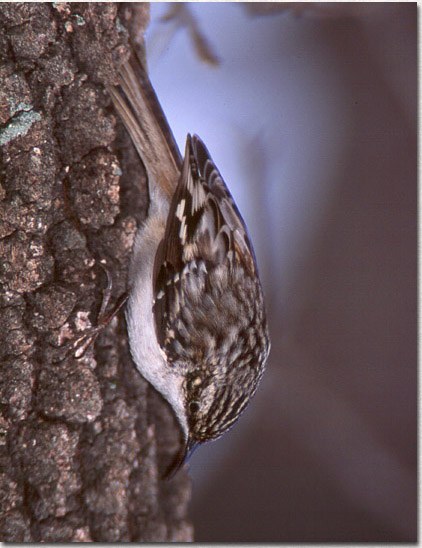
Brown Creeper
- Habitat
- Mixed forests, conifers, dense swampy forests with dead trees
- Size
- 5–5¾ in
- Lifespan
- Poorly studied given its small size and secretive habits; the oldest banding record is only about 5 years.
- Diet
- Insects, nuts, seeds, spiders, other invertebrates, some acorns/beechnuts; young are fed almost entirely animal food
About the Brown Creeper
The Brown Creeper is a small, slender bird whose mottled brown, streaked upperparts blend almost seamlessly with tree bark, while its underparts are plain whitish with a buffy tinge along the flanks. A thin, slightly downcurved bill and a stiff, pointed tail -- used much like a woodpecker's as a brace against the trunk -- round out its specialized build, and at just 5 to 5.75 inches, it's easy to overlook against the bark it so closely resembles. It is the only member of its genus found in North America, part of a small, mostly Old World family of bark-foraging specialists, and its high-pitched, thin song, often described as a delicate series of see-see-see notes ending in an upslurred trill, is pitched near the upper edge of many people's hearing range.
This species favors mixed forests, conifer stands, and dense, swampy woodlands with plenty of standing dead or dying trees, whose loose or furrowed bark provides both foraging crevices and, farther north in the breeding range, nest sites tucked behind peeling bark. There the female builds a distinctive hammock-shaped nest wedged into the gap between loose bark and trunk, woven from twigs, moss, and spider silk into a shape that conforms neatly to the curved space it occupies. In Oklahoma the Brown Creeper is present only in winter, arriving as forests farther north become inhospitable and departing again before the breeding season, so any sighting in the state is a cold-weather one.
Feeding almost entirely on small invertebrates gleaned from bark crevices -- insects, spiders, and other small creatures -- the creeper supplements this with nuts and seeds, including acorns and beechnuts, though nestlings farther north are raised almost exclusively on animal food for the protein it provides. Its foraging pattern is distinctive and diagnostic: rather than working a trunk up and down like a nuthatch, it spirals upward from near the base of a tree, then flies down to the base of a neighboring trunk to start climbing again, working through a patch of forest tree by tree, gleaning insects other bark-foraging birds may pass over because of its close, methodical search pattern.
When alarmed, the Brown Creeper has an effective escape strategy: rather than fleeing, it presses its body flat against the bark, wings spread, relying on its cryptic streaked pattern to disappear against the trunk until the threat passes. On especially cold winter nights, creepers have also been documented roosting communally, pressed into a shallow bark crevice or even excavating a small depression in soft bark specifically for shelter, huddling together in small groups to conserve body heat, a behavior that likely helps the tiny bird survive Oklahoma's occasional hard winter cold snaps. Because of its small size, quiet habits, and the difficulty of studying such an inconspicuous bird, relatively little longevity data exists for the species, and even the oldest known banding record -- only about 5 years -- is modest compared to many similarly sized songbirds. Its plain, quiet demeanor and habit of working the lower and middle trunk mean it is very easily overlooked entirely, even by experienced birders scanning the same tree for more conspicuous species.
In Oklahoma, wintering creepers often join mixed foraging flocks led by chickadees, titmice, and kinglets, tagging along as the flock moves through a woodlot and picking off insects stirred loose or simply overlooked by the flock's more active members, a loose association that likely offers the creeper extra protection from predators as well as better foraging odds in unfamiliar winter territory. Because it forages so differently from woodpeckers and nuthatches, gleaning surface insects rather than excavating wood or probing crevices head-first, the Brown Creeper avoids direct competition with those more familiar bark-foragers even while sharing the very same trees. Birders searching for the species in winter do best scanning the lower and middle trunks of larger, older trees in mature woodland, since creepers rarely venture into small saplings or open, young growth that lacks the deeply furrowed bark they depend on.
Frequently asked questions
How does a Brown Creeper forage on tree trunks?
It spirals upward from near the base of one tree, then flies down to the base of a neighboring tree to start climbing again.
Is the Brown Creeper present in Oklahoma year-round?
No, it's only found in the state during winter, moving south from its more northerly breeding range.
How does a Brown Creeper avoid predators?
It freezes flat against the bark with wings spread, relying on its streaked brown camouflage to blend in until danger passes.
What does the Brown Creeper's tail help it do?
Its stiff, pointed tail acts as a brace against the trunk while climbing, similar to how woodpeckers use their tails.
Where does the Brown Creeper build its nest?
Farther north on its breeding grounds, it wedges a hammock-shaped nest of twigs, moss, and spider silk into the gap behind a slab of loose or peeling bark.
Where to find it
This species favors wetland habitat. See real Oklahoma locations on the Habitats map.