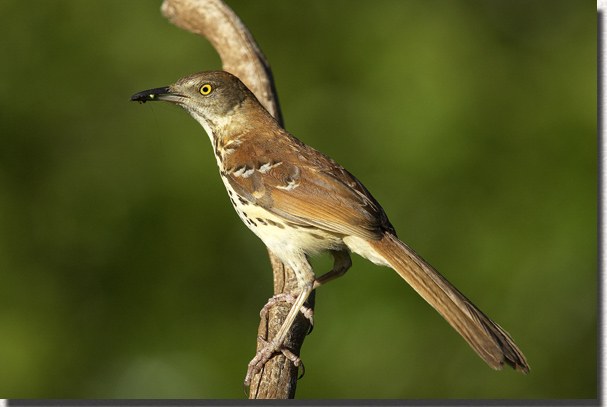
Brown Thrasher
- Habitat
- Woodland edges, brushy areas, hedges, roadsides, gardens, thorn thickets; usually near ground, sometimes singing from an exposed perch
- Size
- 11½ in
- Lifespan
- The oldest banded bird lived almost 11 years, with some sources citing records up to 12 years.
- Diet
- Insects, invertebrates, small vertebrates; berries, fruit, nuts
About the Brown Thrasher
The Brown Thrasher is a striking, long-tailed songbird, rich rufous-brown above with bold dark streaking across a white breast, a slender downcurved bill, and a piercing bright yellow eye that stands out even at a distance. At 11.5 inches it is notably larger than the true thrushes it's often mistaken for, despite an unrelated name and lineage -- it actually belongs to the mimid family alongside mockingbirds and catbirds, a relationship reflected in its vocal talents. The sexes look alike, with no reliable plumage difference between males and females, so pairs are typically distinguished in the field only by behavior, such as which bird sings from the exposed perch.
This species keeps close to dense cover, favoring woodland edges, brushy tangles, hedgerows, roadside thickets, gardens, and thorny scrub, generally staying low and skulking through vegetation rather than venturing into the open, though males will sing from an exposed perch atop a shrub or small tree to advertise territory. That combination of secretive ground-level habits with occasional bold singing perches makes the Brown Thrasher a bird more often heard than seen through much of the year. Populations in the northern part of the range migrate south for winter, while many birds in Oklahoma and points south remain resident year-round, shifting only locally in response to food and weather.
Foraging mostly on or near the ground, the Brown Thrasher uses its curved bill to flip through leaf litter in search of insects, other invertebrates, and even small vertebrates, while also taking a substantial amount of berries, fruit, and nuts, particularly outside the breeding season. This ground-sweeping foraging style, tossing aside leaves and debris with sideways swipes of the bill, is shared with other mimids and lets the thrasher access prey buried under litter that many other songbirds pass over. The bulky, twiggy nest is usually built low in a dense shrub or thicket, and a pair may raise two broods across a season if conditions allow, with both parents sharing feeding duties once the eggs hatch.
Although generally shy and quick to retreat into cover when approached, the Brown Thrasher becomes remarkably bold in defense of its nest and young, aggressively confronting intruders many times its size, including humans, snakes, and even cats, and it has been documented drawing blood with repeated strikes. Vocally, it holds the record among North American birds for the largest song repertoire, with some individuals capable of over a thousand distinct song phrases, often delivering paired phrases in a rich, musical, and highly varied performance that outshines even the related Northern Mockingbird's famous mimicry; unlike the mockingbird, though, the thrasher's phrases seem to be largely original rather than direct copies of other species' songs, suggesting a genuinely creative rather than purely imitative vocal repertoire. The Brown Thrasher also holds the distinction of being the official state bird of Georgia, chosen in part for its bold, garden-loving personality and its long-standing place in southern folklore and literature. Loss of the brushy, early successional habitat it depends on, as overgrown fields mature into forest or are cleared for development, has been linked to gradual population declines in parts of its range over recent decades.
Courtship in this species is relatively understated compared with some songbirds, typically involving the male following and singing near the female rather than performing elaborate visual displays, and pair bonds generally last for the duration of a single breeding season. Juvenile thrashers resemble the streaked, rufous-brown adults fairly closely but often show a somewhat duller eye color that brightens to the full vivid yellow over their first year, one of the few age cues available to observers trying to sort young birds from adults later in the season. In Oklahoma's backyards and hedgerows, the species is often first noticed not by sight but by the sudden explosive rustle of leaf litter as a foraging thrasher works quickly through a patch of ground cover, a sound distinctive enough that many experienced birders can identify the species without ever seeing it.
Frequently asked questions
Is the Brown Thrasher actually a thrush?
No, despite the resemblance and frequent confusion, it belongs to the mimid family along with mockingbirds and catbirds.
How aggressive is the Brown Thrasher in defending its nest?
Very -- it will boldly attack intruders far larger than itself, including cats, snakes, and people, sometimes drawing blood.
What is special about the Brown Thrasher's song?
It holds the record for the largest song repertoire of any North American bird, with some individuals singing over a thousand distinct phrases.
How does the Brown Thrasher find food?
It forages mostly on the ground, using its curved bill to sweep aside leaf litter in search of insects and other invertebrates.
Does the Brown Thrasher mimic other birds like a mockingbird does?
Not really -- while it's a close relative of the Northern Mockingbird and shares its paired-phrase singing style, most of its varied song phrases appear to be original rather than direct copies of other species.
Where to find it
This species favors forest habitat. See real Oklahoma locations on the Habitats map.