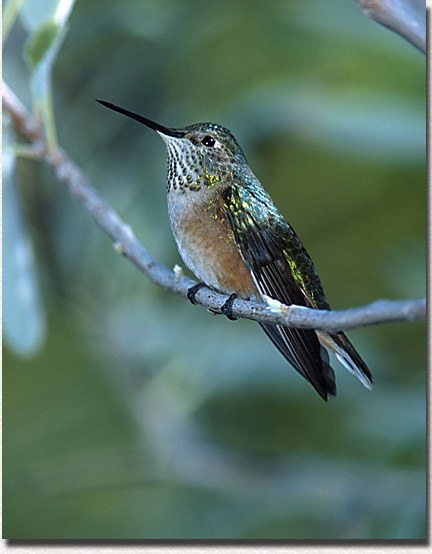
Broad-tailed Hummingbird
Selasphorus platycercus
- Habitat
- Mountain meadows, aspen groves, and coniferous forest edges, typically at higher elevations
- Size
- 3.5-4 in
- Lifespan
- An exceptional record exists: a banded female recaptured repeatedly in Colorado over the years was documented living at least 12 years, 2 months, among the oldest ages ever confirmed for a wild hummingbird.
- Diet
- Nectar from tubular flowers, supplemented with small insects and spiders for protein
About the Broad-tailed Hummingbird
The Broad-tailed Hummingbird is a medium-sized hummingbird for its family, with a fairly stocky build compared to some western relatives. Males show an iridescent rose-magenta throat patch (gorget) that flashes brilliant pink in direct light but can look dark or black from other angles, paired with a green back and crown and whitish underparts. Females lack the colorful gorget and instead show a spotted throat and buffy sides, making them harder to distinguish from some other western hummingbirds like the Rufous without a careful look at tail shape and pattern.
It breeds through the Rocky Mountain region and other higher-elevation habitats of the western United States, generally favoring montane meadows and open aspen or coniferous woodland between roughly 6,000 and 10,000 feet, often near streams or wet meadows rich in flowers. In Oklahoma it is a rare and casual visitor, most likely to turn up in the western Panhandle during migration, well east and lower in elevation than its core breeding range; sightings elsewhere in the state are exceptional. It winters in Mexico, generally in similar highland habitat.
This species hovers to feed at tubular red and pink flowers such as scarlet gilia, various penstemons, and columbine, often defending productive flower patches aggressively against rivals with chases and dive displays. Like other hummingbirds it also hawks small flying insects in midair and gleans spiders from webs, a protein source that becomes especially important while feeding nestlings, since nectar alone cannot support their growth.
Its most distinctive trait is entirely acoustic: specialized, narrowed tips on the male's outer flight feathers vibrate in the air to produce a loud, metallic trill audible well before the bird itself is seen, both during ordinary flight and in the male's dramatic diving courtship display, in which he climbs high into the air before plunging steeply past a perched female. Females alone build the tiny, lichen-camouflaged cup nest, often reused or rebuilt on the same site across multiple years, and raise the young without any help from the male, incubating and feeding chicks entirely on her own. Like other hummingbirds, this species relies on a nightly state of torpor at high, cold elevations, dramatically slowing its metabolism and body temperature overnight to conserve the energy reserves it can't otherwise store in its tiny body.
Frequently asked questions
Is the Broad-tailed Hummingbird common in Oklahoma?
No, it is a rare vagrant here; its breeding range is centered in the Rocky Mountains well to the west.
Why does its wing make a trilling sound?
Narrowed tips on the male's outer flight feathers vibrate during flight, producing a distinctive metallic trill unique to the species.
How high in elevation does it typically nest?
Usually between about 6,000 and 10,000 feet, often near flower-rich montane meadows.
How long can hummingbirds live?
Most live only a few years, but the Broad-tailed Hummingbird holds one of the best-documented longevity records for the group, at over 12 years.
Where to find it
This species favors forest habitat. See real Oklahoma locations on the Habitats map.