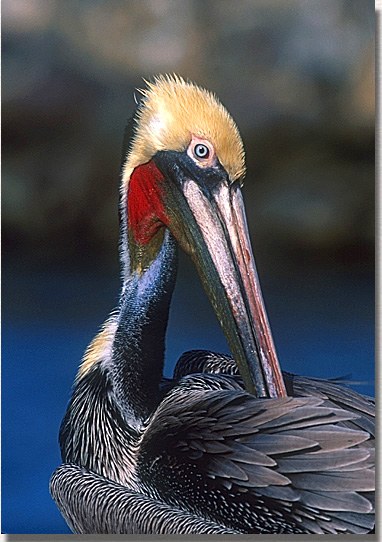
Brown Pelican
- Habitat
- Coastal waters, bays, and estuaries; only rarely seen well inland on large reservoirs
- Size
- 45-54 in long, with a wingspan up to about 7 ft
- Lifespan
- Survival past 10 years is uncommon for this species (well under 2% of banded birds), but a small number of exceptional individuals have been recorded living to 31, 37, and even 43 years.
- Diet
- Primarily fish, especially schooling species like menhaden and anchovies, caught by plunge-diving
About the Brown Pelican
The Brown Pelican is a large, unmistakable waterbird with a grayish-brown body and an enormous bill bearing an expandable throat pouch used to scoop up fish. Breeding adults have a white-to-yellow head with a dark chestnut nape and a reddish or dark bill, while juveniles are plain brown overall, including the head, until they mature over several years. Flocks are often seen flying in coordinated lines low over the water's surface, gliding on set wings between slow, synchronized wingbeats.
It is primarily a coastal species found along the Gulf Coast and both the Atlantic and Pacific coastlines of the Americas. It isn't a typical Oklahoma bird, but individuals, especially wandering young birds, occasionally show up on large lakes and reservoirs in the state, usually after the breeding season when young pelicans disperse widely. The species suffered a severe population crash in the mid-20th century due to the pesticide DDT, which accumulated in the food chain and thinned eggshells so severely that they often broke under the weight of incubating adults, causing widespread nest failure across its range. Following the 1972 US ban on DDT, its numbers recovered dramatically over the following decades, and it was removed from the federal Endangered Species List in 2009, a widely cited conservation success story.
Brown Pelicans hunt with a dramatic plunge-dive, dropping from heights that can reach 60 feet or more and twisting their body sharply just before impact to protect the trachea and esophagus from the force of hitting the water. After surfacing, the bird drains water from its pouch, tilting its head down before swallowing its catch, a brief pause during which gulls will sometimes attempt to steal the fish directly from its bill or pouch.
The species nests colonially on coastal islands, often in large numbers, building simple ground or low shrub nests of sticks and grass. Beyond its dramatic fishing technique, its pouch itself is a marvel of adaptation, able to hold roughly three times more volume than its stomach, allowing it to scoop up multiple fish in a single dive before draining and swallowing. Its near-total recovery from the DDT era, achieved largely through regulatory action rather than direct intervention, remains one of the best-documented and most encouraging conservation success stories in North American ornithology.
Frequently asked questions
Would I really see a Brown Pelican in Oklahoma?
It's uncommon but not impossible; wandering individuals, especially young birds, occasionally turn up on large lakes and reservoirs after the breeding season.
Why did Brown Pelicans decline so severely?
The pesticide DDT caused eggshell thinning that crushed nests; banning DDT in 1972 allowed the population to rebound over subsequent decades.
How does it catch fish?
It plunge-dives from the air, sometimes from significant height, stunning fish before scooping them up in its expandable throat pouch.
How long do Brown Pelicans live?
Most don't survive past 10 years, but banding records show a few individuals reaching past 30 years, with the oldest known living to 43.
Where to find it
This species favors wetland habitat. See real Oklahoma locations on the Habitats map.