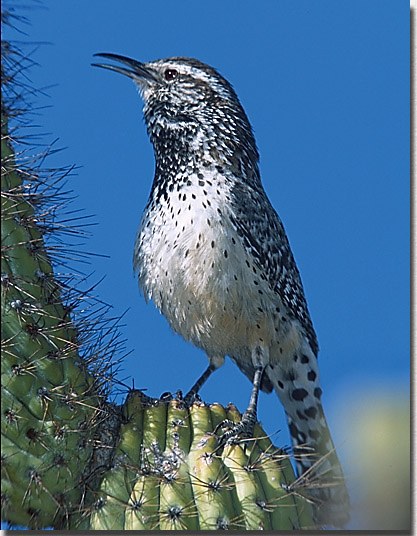
Cactus Wren
- Habitat
- Arid desert scrub dominated by cactus and thorny shrubs
- Size
- 7-9 in
- Lifespan
- Banding records document individuals living to around 8 years in the wild.
- Diet
- Insects and spiders, supplemented with some fruit and seeds
About the Cactus Wren
The Cactus Wren is the largest wren in North America, noticeably bulkier and longer-billed than familiar backyard wrens. It has heavily spotted and streaked brown-and-white plumage, a bold white eyebrow stripe, and a breast marked with dark spots that become barring toward the flanks and tail. Its voice matches its bold appearance and behavior: a harsh, low-pitched, mechanical churring quite unlike the melodic, bubbling songs of most other wrens, often given from a conspicuous perch atop a cactus or shrub.
It is a characteristic bird of the Sonoran and Chihuahuan desert regions of the American Southwest, common in Arizona, New Mexico, and adjacent areas. In Oklahoma it barely reaches the eastern edge of its range in the drier western Panhandle, where patches of suitable cactus and mesquite scrub occur, making it an uncommon and highly localized species in the state compared to its abundance farther southwest. Unlike many desert birds, the Cactus Wren rarely needs to drink free water at all, meeting most of its moisture needs from the insects and fruit it eats, a physiological adaptation that lets it remain active and territorial through the hottest parts of the desert day when many other birds retreat to shade.
Cactus Wrens forage mostly on the ground, flipping over debris, leaf litter, and small stones and probing crevices for ants, beetles, and other invertebrates, occasionally taking small lizards as well. They also eat cactus fruit and seeds, particularly when insect availability drops during dry periods, and are bold enough to forage in the open through the heat of the day when many other desert birds retreat to shade.
The species builds a large, football-shaped nest of grass and plant fiber with a tunnel-like side entrance, typically wedged deep within the protective spines of cholla or another cactus for defense against snakes and mammalian predators. Nest entrances are often oriented to face away from the prevailing hot afternoon sun and wind, a subtle but consistent placement choice that likely helps moderate temperatures inside the nest chamber. Pairs build and maintain multiple nests throughout the year, well beyond what's needed for a single breeding attempt, using the extras as nighttime roosting shelters that help them cope with the desert's extreme day-to-night temperature swings, retreating into a familiar nest structure after dark much as a mammal might use a den.
It is the state bird of Arizona, chosen in part for its familiarity and hardiness in desert conditions. Cactus Wrens are also non-migratory and highly territorial year-round, with pairs typically remaining together on the same patch of desert scrub for life, defending it against other wrens in every season rather than only during the breeding period. Older offspring from an earlier brood sometimes linger near their parents' territory and have occasionally been observed helping to feed younger siblings, a loosely cooperative pattern more commonly associated with some tropical wren species. Because it depends so heavily on large cholla and other columnar cacti for both nesting and shelter, the species has become notably scarcer in parts of its range, such as coastal Southern California, where urban development and habitat clearing have removed much of the cactus scrub it requires, a warning sign that even a hardy, adaptable desert specialist can be vulnerable to the loss of one key habitat feature. Family groups typically remain in loose contact through harsh desert winters, and the species' rattling calls can often be heard year-round from the same territory, a helpful clue for visitors to the Panhandle's scattered patches of cactus country trying to track down this localized edge-of-range specialty.
Frequently asked questions
Is the Cactus Wren common in Oklahoma?
No, it's an uncommon, localized species found mainly in cactus and mesquite scrub habitat in the far western Panhandle.
Why does it build its nest inside a cactus?
The spines of cholla or other cactus provide strong physical protection against snakes, mammals, and other nest predators.
Does the Cactus Wren build more than one nest?
Yes, pairs often build several nests through the year and use the extras as roosting shelters outside the breeding season.
What does its call sound like?
A harsh, low, mechanical-sounding churring, often described as 'chug-chug-chug,' quite different from the pleasant song of most wrens.
Does the Cactus Wren need to drink water often?
Not much -- it gets most of its moisture from the insects and fruit it eats, an adaptation that lets it stay active through the hottest desert days.
Where to find it
This species favors grassland habitat. See real Oklahoma locations on the Habitats map.