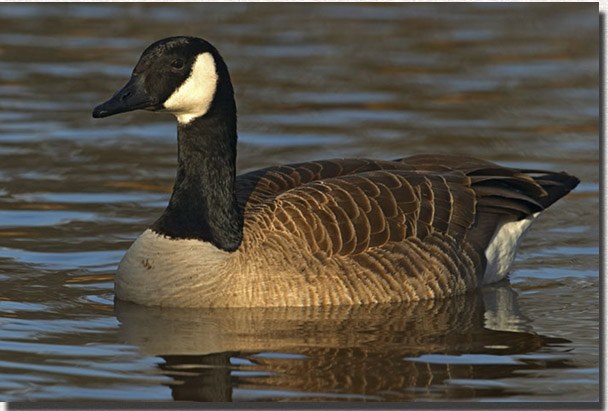
Canada Goose
- Habitat
- Lakes, ponds, rivers, marshes, parks, and agricultural fields; highly adaptable to human landscapes
- Size
- 30-43 in, varying by subspecies
- Lifespan
- Typically 10-24 years in the wild; the oldest banded individual on record was 33 years, 3 months old.
- Diet
- Grasses, sedges, aquatic plants, and agricultural grain, especially waste corn and wheat
About the Canada Goose
The Canada Goose is a large waterfowl species with a black head and neck set off by a bold white 'chinstrap,' a brown body, and pale breast. Size and voice vary noticeably among its several recognized subspecies, ranging from small, high-pitched 'cackling' forms breeding in the Arctic to large, deep-voiced resident birds common across the Lower 48, a range of variation that has at times led to taxonomic debate over how many species are really involved; in 2004 the smallest, high-Arctic forms were formally split off entirely into a separate species, the Cackling Goose, leaving the Canada Goose proper as the larger-bodied forms familiar across most of the continent.
It is abundant and familiar across Oklahoma throughout the year, found on nearly any body of water as well as adjacent lawns, golf courses, and farm fields, often in large flocks outside the breeding season. The state hosts both migratory birds that breed farther north and winter here, and a large resident, non-migratory population established through decades-old stocking programs originally intended to boost hunting opportunities, reflecting the species' remarkable adaptability to human-altered landscapes and its tolerance of close proximity to people.
Canada Geese graze on grasses and grain in fields and lawns and dabble in shallow water for aquatic vegetation, sometimes tipping up like a dabbling duck to reach submerged plants. They readily accept food from people, a habit that has helped fuel large urban and suburban populations that some communities consider a nuisance around parks and retention ponds due to droppings and aggressive behavior near nests. Adult geese undergo a complete molt of their flight feathers once a year, usually in mid-summer, becoming flightless for several weeks; non-breeding and failed-breeding birds often gather at traditional molting sites in large flocks during this vulnerable period, relying on open water and safety in numbers until new feathers grow in.
Pairs form strong, generally long-term bonds, and both parents fiercely defend their nest and goslings, hissing and charging at intruders including much larger animals and people. One of the more genuinely interesting facts about the species is the aerodynamics behind its famous V-formation migratory flight: each bird gains a measurable lift benefit from the wingtip vortex created by the bird just ahead of it, reducing the energy needed for long flights, and individuals periodically rotate through the more tiring lead position to share the workload, a cooperative flying strategy that likely helps the species cover very long migratory distances efficiently.
Goslings are precocial, able to walk, swim, and feed themselves within hours of hatching, though they stay close to their parents for protection and guidance through their first year, sometimes even migrating together as a family group the following autumn. Young geese also imprint strongly on their parents almost immediately after hatching, a rapid learning process that anchors the family bond and helps goslings recognize and follow the correct adults through their vulnerable early weeks. Family groups sometimes merge into larger creches later in the season, with several broods loosely tended together, a pattern that may improve overall vigilance against predators such as foxes, coyotes, and snapping turtles that target young goslings.
Canada Geese communicate through a surprisingly varied vocabulary beyond the familiar honking flight call, including low murmuring contact notes between mates, hissing threat displays, and distinct alarm calls that can rally an entire flock into flight within seconds. In parts of Oklahoma where resident flocks have grown especially large, wildlife agencies sometimes manage numbers through addled-egg programs or relocation efforts, since dense urban populations can degrade water quality in small ponds and create conflicts with mowing, golfing, or foot traffic on shared open ground. Despite these localized management challenges, the species remains a conservation success story overall, having rebounded from significantly reduced numbers in the early twentieth century to become one of the most numerous and visible waterfowl species in North America today.
Frequently asked questions
Do all Canada Geese migrate?
No, Oklahoma has both migratory populations that winter here and resident, non-migratory flocks that remain year-round.
Why do geese fly in a V-formation?
Each bird benefits from reduced air resistance created by the wingtip vortex of the bird ahead, saving energy on long flights.
Do Canada Geese mate for life?
They typically form long-term, often lifelong pair bonds, though a bird will re-pair if its mate dies.
How long do Canada Geese live?
Wild birds commonly live well over a decade, and the oldest banded individual on record reached just over 33 years old.
Is the small Arctic-breeding form of Canada Goose the same species?
Not anymore -- in 2004 the smallest, high-Arctic breeding forms were reclassified as a separate species, the Cackling Goose, distinct from the larger-bodied Canada Goose.
Where to find it
This species favors wetland habitat. See real Oklahoma locations on the Habitats map.