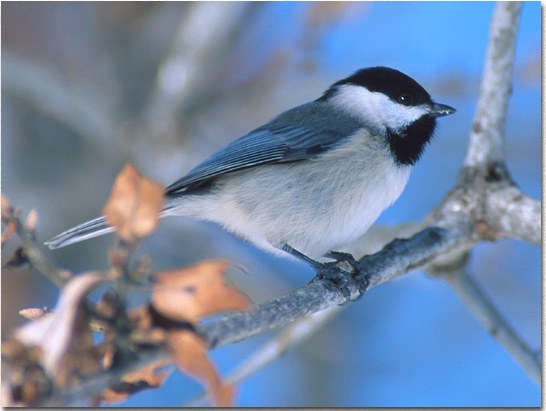
Carolina Chickadee
- Habitat
- Mixed deciduous-coniferous forests, woodland edges, swampy areas, clearings, fields, thickets, orchards, suburbs, valleys, foothills; prefers woods more than the Black-capped Chickadee
- Size
- 4–5 in
- Lifespan
- Typical lifespan is about 4-5 years; the oldest banded bird reached almost 11 years.
- Diet
- Insects, seeds, fruit, spiders and their eggs
About the Carolina Chickadee
The Carolina Chickadee closely resembles its northern cousin, the Black-capped Chickadee, sharing the same black cap and bib set against white cheeks and gray back, but it can be told apart with practice by its slightly smaller size, less white edging on the wing feathers, and a more crisply defined, cleanly bordered black bib. At only 4 to 5 inches, it's one of the smallest songbirds regularly seen in Oklahoma's woodlands and neighborhoods.
This chickadee occupies mixed deciduous-coniferous forests, woodland edges, swampy areas, clearings, fields, thickets, orchards, suburbs, valleys, and foothills, and generally shows a stronger preference for wooded habitat than the more habitat-flexible Black-capped Chickadee found farther north. Where the two species' ranges meet, they can hybridize, and separating them by sight alone can be genuinely difficult, with voice often being the more reliable clue.
Insects and spiders, including their egg cases, make up a large share of the diet, especially during the breeding season when protein demands are high, supplemented by seeds and fruit the rest of the year. Chickadees are agile, acrobatic foragers, often hanging upside down from twig tips to reach insects that other birds can't access, and they readily cache surplus food in bark crevices for retrieval later.
Tame and inquisitive, the Carolina Chickadee is a common and enthusiastic visitor to backyard feeders, frequently seen mixing with Tufted Titmice and Downy Woodpeckers in loose foraging flocks that move through the woods together, gaining a measure of safety in numbers. It also reliably responds to "pishing" — the soft scolding noise birders make to draw curious songbirds into view — often approaching closely to investigate along with any titmice or woodpeckers traveling with it. The species nests in a cavity, most often an old woodpecker hole, a natural hollow, or a nest box, and the pair excavates or lines the chamber with moss, plant down, and fur before eggs are laid. Its song, a clear whistled "fee-bee fee-bay," differs distinctly from the buzzier "chick-a-dee-dee-dee" scolding call used for alarm and flock communication, and researchers have found that the number of "dee" notes in that call actually varies with the perceived size of a threat, a rare example of graded, information-rich vocal signaling in a small songbird.
Frequently asked questions
How can you tell a Carolina Chickadee from a Black-capped Chickadee?
Look for a slightly smaller size, less white on the wing edges, and a more sharply defined black bib, though voice is often more reliable than appearance.
Does the Carolina Chickadee visit backyard feeders?
Yes, it's a tame and frequent feeder visitor, often mixing with Tufted Titmice and Downy Woodpeckers.
What does "pishing" do to a Carolina Chickadee?
The soft scolding sound draws the curious, responsive chickadee in closer, often along with other birds traveling in its mixed flock.
What habitat does the Carolina Chickadee prefer?
It favors wooded habitats more strongly than the related Black-capped Chickadee, including mixed forests, woodland edges, and suburban areas with trees.
Where to find it
This species favors forest habitat. See real Oklahoma locations on the Habitats map.