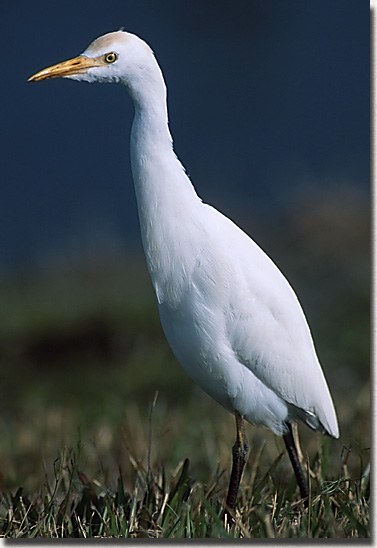
Cattle Egret
- Habitat
- Pastures and agricultural fields near livestock, also wetlands and grasslands
- Size
- 18-20 in
- Lifespan
- Banding records show individuals living to at least 17 years, though most live considerably fewer.
- Diet
- Insects, especially grasshoppers and other invertebrates stirred up by grazing livestock or farm machinery
About the Cattle Egret
The Cattle Egret is a compact, stocky white heron with a shorter neck, shorter legs, and a thicker yellow-orange bill compared to most other egrets, giving it a somewhat hunched, less elegant silhouette than a Great or Snowy Egret. Breeding adults develop buffy-orange plumes on the crown, breast, and back, along with a brief change in bill and leg color, while non-breeding birds appear entirely white with a plain yellow bill.
Native to Africa and southern Asia, the Cattle Egret colonized South America naturally in the late 1800s, likely aided by strong transatlantic winds, and expanded across North America through the mid-20th century, reaching Oklahoma by around the 1960s-70s. It's now common in the state during the warmer months, especially in pastures and farmland where cattle graze, and generally withdraws south for winter. This natural, unassisted colonization of an entire hemisphere within roughly a century is considered one of the most remarkable range expansions recorded for any bird species, achieved with no help from human introduction whatsoever.
Rather than wading for fish like most herons, the Cattle Egret closely follows livestock or farm machinery, walking alongside grazing cattle or behind tractors and mowers to snatch grasshoppers and other insects flushed by their movement through the grass. This commensal foraging strategy takes far less energy than actively hunting for aquatic prey, and the species will also forage in loose flocks in open fields away from any water at all, unusual among herons. In its native range the same behavior extends to following large wild grazing mammals such as African buffalo and elephants, suggesting the egret's foraging partnership with cattle is simply a substitution of one large grazing animal for another rather than a fundamentally new behavior developed in the Americas.
It nests colonially, often in mixed rookeries alongside other herons and egrets in trees near water, sometimes in very large numbers, and pairs perform modest courtship displays involving neck-stretching and bill-clattering before settling into a shared nest-building routine. Genuinely remarkable is the species' natural spread from Africa to the Americas and across most of the continental United States within roughly a century, entirely without human introduction, closely tracking the global expansion of cattle ranching and providing a steady supply of the disturbed-ground foraging opportunities it depends on.
Unlike most herons, it rarely wades in water at all, and its diet of grassland insects rather than fish or aquatic prey has allowed it to thrive in dry pasture landscapes far from the wetlands most of its heron relatives depend on. In parts of its range it has also been noted foraging around wildfires and controlled burns, snatching insects and small animals fleeing the flames, a further sign of its opportunistic, disturbance-following lifestyle. Because the species nests in such large mixed colonies, biologists sometimes use Cattle Egret numbers as one convenient indicator when monitoring the overall health and disturbance levels of a shared heron rookery, even though the species itself is generally considered secure and continues to be one of the most numerous herons on the planet. In Oklahoma, the best time to look for Cattle Egrets is during the height of summer, scanning pastures for a small white heron walking briskly among grazing cattle rather than standing motionless at water's edge the way a Great Blue Heron typically hunts; a scattered handful of egrets moving with a herd, occasionally hopping up onto a cow's back to pick off flies, is one of the more reliable and easily overlooked wildlife spectacles of the state's ranch country.
Frequently asked questions
Why is it called a Cattle Egret?
It commonly forages alongside grazing cattle and other livestock, catching insects the animals stir up from the grass.
Is the Cattle Egret native to North America?
No, it originated in Africa and Asia and colonized the Americas on its own, reaching Oklahoma by around the 1960s-70s.
How does it differ from other white egrets?
It's stockier and shorter-necked than the Great or Snowy Egret, with a thicker yellow-orange bill and buffy breeding plumes rather than pure white plumage.
Does the Cattle Egret eat fish like other herons?
Rarely; it feeds mainly on insects and other invertebrates in dry grassland and pasture rather than wading for fish.
Did the Cattle Egret only start following cattle after reaching the Americas?
No, in its native Africa and Asia it follows large wild grazing animals like buffalo and elephants the same way, so following cattle in the Americas is simply a substitution of one grazing partner for another.
Where to find it
This species favors grassland habitat. See real Oklahoma locations on the Habitats map.