Cliff Swallow
- Habitat
- Open country near cliffs, bridges, culverts, or buildings with vertical nesting surfaces, usually close to water
- Size
- 5-6 in
- Lifespan
- Banding records show individuals living to around 11 years, though average annual survival is far lower.
- Diet
- Flying insects caught entirely on the wing
About the Cliff Swallow
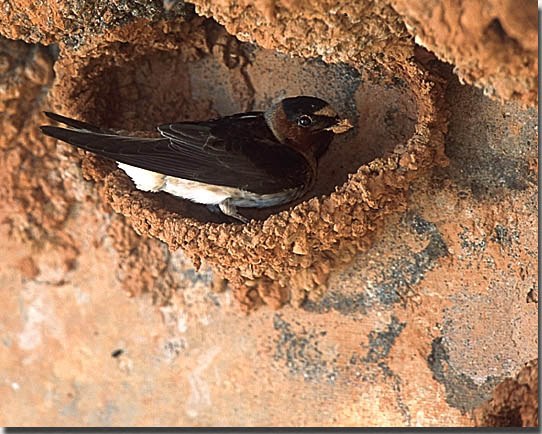
The Cliff Swallow is a small, stocky swallow with a squared tail, unlike the deeply forked tail of the closely related Barn Swallow, along with a pale buffy rump patch, dark rufous face, steel-blue crown and back, and a pale forehead patch that varies in color from whitish to rusty across different populations. In flight the combination of squared tail and pale rump is usually enough to distinguish it from other swallows sharing the same airspace, though in parts of Oklahoma it can also be confused with the similarly buffy-rumped Cave Swallow, which favors culverts and cave-like structures and has a more solidly rufous forehead.
It's a widespread summer breeder across Oklahoma, especially wherever bridges, culverts, and highway overpasses provide the vertical concrete surfaces the species has readily adapted to using in place of natural cliffs, a shift that has allowed it to expand well beyond its historic range in canyon and cliff country. It's almost always found near open water or wetlands, where flying insects are abundant, and winters far to the south in South America, undertaking one of the longer migrations of any North American swallow.
As an aerial insectivore, the Cliff Swallow catches all its food in flight, often foraging over water or fields in loose flocks that may mix with Barn Swallows, Tree Swallows, or Purple Martins. Feeding activity peaks at dawn and dusk, when flying insects are most abundant, and birds may travel considerable distances from the colony to find good foraging conditions, especially during cool or wet weather when insects are scarce near the nest site.
The species builds distinctive gourd-shaped mud nests with a narrow tubular entrance, plastered directly onto vertical surfaces in dense colonies that can range from a handful of pairs to several thousand, with birds making repeated trips to gather wet mud pellets from nearby puddles or shorelines. Within these dense colonies, extra-pair mating and even a limited form of egg-dumping into a neighbor's nest have both been documented by researchers studying the species closely, a level of social complexity unusual among songbirds and one reason Cliff Swallow colonies have become a long-running model system for studying colonial bird behavior. Colonies also attract specialized ectoparasites, notably a blood-feeding swallow bug related to bedbugs, and heavy infestations can influence which nest sites birds choose to reuse or abandon in subsequent years.
The famous swallows of Mission San Juan Capistrano in California made the species' spring return a folk symbol of seasonal renewal, and its shift from natural cliff faces to human-built bridges and buildings has made it one of the most successful colonial nesting birds in North America, though entire colonies can also fail quickly to heavy rain, which can wash mud nests off their supports, or to predators such as snakes. Researchers have also found that some populations nesting along roadways have shown shifts in wing shape over recent decades, thought to reduce collisions with vehicles, a small but striking example of a wild bird population adapting to a distinctly modern hazard. Both parents share incubation and feeding duties once a clutch hatches, and adults are able to recognize the calls of their own chicks amid the constant noise of a crowded colony, allowing them to deliver food to the correct nest despite dozens or hundreds of nearly identical mud structures packed within inches of one another. In Oklahoma, the arrival of the first Cliff Swallows each spring, usually gathering in growing numbers around a familiar bridge or overpass, is for many local birdwatchers as reliable a seasonal marker as the blooming of redbud trees.
Frequently asked questions
How is the Cliff Swallow different from the Barn Swallow?
Cliff Swallows have a squared tail and a pale rump patch, while Barn Swallows have a deeply forked tail and lack the pale rump.
Why do Cliff Swallows nest under bridges?
Bridges and overpasses mimic the vertical cliff faces the species naturally nests on and are often conveniently close to water and insect-rich foraging areas.
How big can a Cliff Swallow colony get?
Colonies range from a handful of nests to several thousand packed tightly together on a single structure.
What are Cliff Swallow nests made of?
Hundreds of tiny mud pellets, carried one beakful at a time and plastered together into a gourd-shaped structure.
Is the Cliff Swallow easily confused with any other swallow in Oklahoma?
Yes, the Cave Swallow looks similar with its buffy rump, but it has a more solidly rufous forehead and tends to favor culverts and cave-like structures.
Where to find it
This species favors wetland habitat. See real Oklahoma locations on the Habitats map.