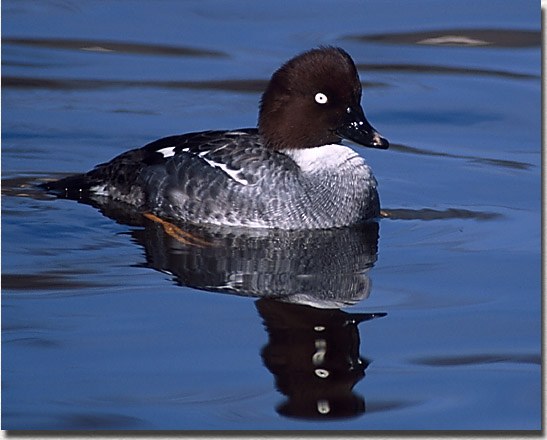
Common Goldeneye
- Habitat
- Boreal lakes and rivers near forest for breeding as a cavity nester; large lakes, rivers, and coastal bays in winter
- Size
- 16-20 in
- Lifespan
- Banding records indicate individuals can live 15-20 years in the wild.
- Diet
- Aquatic invertebrates, small fish, and mollusks obtained by diving
About the Common Goldeneye
The Common Goldeneye is a medium-sized diving duck with a puffy, triangular-shaped head that gives it a distinctive silhouette on the water even at a distance. Males show a glossy dark green head with a round white spot in front of the bright yellow eye, set against a black-and-white body, while females have a chocolate-brown head and gray body with a whitish collar. Both sexes are named for the striking golden-yellow iris shared by the species, visible even in relatively low light. The closely related, and less common, Barrow's Goldeneye shows a similar overall pattern but with a crescent-shaped rather than round facial spot on males and a steeper forehead, and the two species can occasionally be confused where their ranges overlap farther north and west.
It breeds in cavity-rich boreal forest across Canada and the northern United States, nesting in tree holes near clear lakes and rivers. In Oklahoma it occurs strictly as a winter visitor, found on larger lakes, reservoirs, and rivers, usually in modest numbers alongside other diving ducks such as scaup and Ring-necked Ducks, generally arriving as temperatures drop in late fall.
Common Goldeneyes dive to the bottom of lakes and rivers in search of crustaceans, aquatic insect larvae, mollusks, and small fish, using their feet for underwater propulsion. They're strong swimmers, often foraging in relatively shallow water compared to some other diving duck species, and can remain submerged for a surprisingly long time relative to their size.
The species nests in tree cavities, sometimes reusing old woodpecker holes, and takes readily to artificial nest boxes where they're provided, a management tool used in parts of its breeding range. Its wings produce a distinctive, loud whistling tone in flight, audible well before the bird comes into view, which earned it the old colloquial nickname 'whistler' among waterfowl hunters. Ducklings leap unharmed from nest cavities that can be well above the ground within a day or two of hatching, dropping to the forest floor before being led by the female overland and then to water, one of several diving ducks that share this dramatic early-life behavior.
Common Goldeneyes also show strong site fidelity, with females often returning to nest in the same general area, and sometimes even the same cavity, in successive years if it produced a successful brood previously. Courting males perform an elaborate head-throw display, snapping the head sharply back onto the rump while calling, one of the more theatrical courtship rituals among North American ducks, and these displays are often performed communally by several males around one or two females well before pairing is finalized in late winter. Because females readily use nest boxes when natural cavities are scarce, targeted nest-box programs in parts of Scandinavia and North America have helped support local breeding populations in landscapes where old, cavity-rich trees have become less common, an approach borrowed from similar successful efforts for Wood Ducks.
In Oklahoma, the best places to look for wintering Common Goldeneyes are typically the deeper, colder waters of large reservoirs, where they often keep somewhat apart from the state's more numerous dabbling ducks, diving repeatedly in the same general area rather than dabbling at the surface. Flocks are usually small compared with the state's wintering scaup or Ring-necked Duck numbers, and birders often first notice the species by its distinctive whistling wingbeats overhead before spotting the bird itself on the water. Because the species is relatively cold-hardy and sticks to open water even in fairly harsh conditions, a hard freeze that pushes other diving ducks off small ponds can sometimes concentrate goldeneyes onto the larger, more reliably ice-free lakes and rivers that remain open through the coldest stretches of an Oklahoma winter.
Frequently asked questions
Why is it called the Goldeneye?
Both sexes have a bright golden-yellow iris that stands out sharply against their dark head plumage.
Is the Common Goldeneye a summer or winter bird in Oklahoma?
Winter only; it breeds far to the north in Canada and the northern US and comes south to Oklahoma's lakes and rivers in the cold months.
Why does it make a whistling sound in flight?
Its wings produce a mechanical whistling tone, giving rise to the old nickname 'whistler' among waterfowl hunters.
Where does the Common Goldeneye nest?
In tree cavities near water, sometimes many feet above the ground, and readily in artificial nest boxes where they're provided.
How can you tell a Common Goldeneye from a Barrow's Goldeneye?
Males differ mainly in the shape of the white facial spot -- round in the Common Goldeneye and crescent-shaped in the rarer Barrow's Goldeneye -- along with subtle differences in head shape.
Where to find it
This species favors wetland habitat. See real Oklahoma locations on the Habitats map.