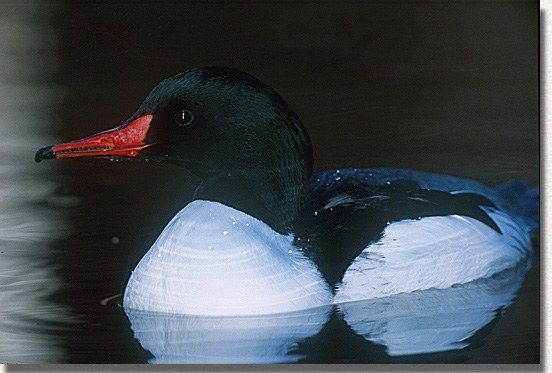
Common Merganser
- Habitat
- Forested rivers and lakes, nesting in tree cavities near clean, fish-rich water
- Size
- 21-28 in
- Lifespan
- Banding records show individuals living to around 13 years in the wild.
- Diet
- Primarily fish, caught by underwater pursuit diving
About the Common Merganser
The Common Merganser is a large, sleek diving duck with a slender, serrated bill adapted for gripping slippery fish, distinct from the flatter, broader bills of dabbling ducks. Breeding males show a dark green head, white body, and black back, with a subtle pinkish flush to the underparts early in the season, while females have a rich cinnamon head with a shaggy crest that contrasts sharply with a gray body and clean white throat and chin. The species is noticeably larger and bulkier than the related Red-breasted Merganser, and males of the two are easy to separate, though females of both species look similar enough that head shape and the cleanliness of the throat-to-neck border are often needed to tell them apart.
It breeds across forested regions of Canada and the northern United States along clear rivers and lakes, requiring both fish-rich water and large trees with cavities suitable for nesting. In Oklahoma it occurs as a winter visitor on larger, clearer lakes and rivers, typically in smaller numbers than many other wintering waterfowl, since it favors less turbid water where it can visually spot fish beneath the surface, and it is somewhat more cold-tolerant than most ducks, sometimes lingering on open, ice-free stretches of river later into winter than other waterfowl.
Common Mergansers pursue fish underwater using strong swimming and a serrated, saw-edged bill that grips prey firmly, earning the group the nickname 'sawbills.' They sometimes forage cooperatively, with small groups herding fish into shallow water or a confined space before diving in together, and also take some aquatic invertebrates, amphibians, and occasionally small mammals.
The species nests in large tree cavities, sometimes at considerable distance from water, reusing old woodpecker excavations or natural hollows. Shortly after hatching, ducklings leap unharmed from cavities that can be dozens of feet above the ground, cushioned by their light weight and down, then are led on foot and by swimming to the nearest water by the female. Broods from different females are also known to occasionally merge into large 'creches' of ducklings loosely tended by one or a few adult females, a behavior that may improve overall survival odds for the combined group of young.
Adult males undergo a full flightless molt after breeding, replacing all their flight feathers at once rather than gradually, which leaves them temporarily grounded and forces them to seek out secluded water bodies with abundant cover until new feathers grow in. The species' loud, harsh croaking call, quite different from the whistling tone of some related ducks, is occasionally heard from migrating flocks passing overhead at night during spring and fall. Because it relies so heavily on a diet of fish, the Common Merganser has periodically drawn conflict with fish hatcheries and anglers who perceive it as competition, though studies of its actual impact on managed fish stocks have generally found the effect to be more limited and localized than the reputation suggests.
Sexual size difference in this species is fairly pronounced, with males noticeably larger and heavier than females, a pattern common among diving ducks that some researchers link to the more energetically demanding underwater pursuit-diving lifestyle shared across the group. In Oklahoma, the species tends to favor larger, clearer reservoirs and stretches of major rivers over the smaller farm ponds and marshy wetlands preferred by dabbling ducks, and small groups can often be found resting on open water in the middle of a lake, diving intermittently through the day and generally proving less approachable than many other wintering waterfowl. Because it favors clear water for sight-hunting fish, its local abundance in a given winter can shift noticeably with water clarity, becoming scarcer during periods of heavy runoff or algae bloom that reduce underwater visibility.
Frequently asked questions
Why does the Common Merganser have a serrated bill?
The saw-like edges help it grip slippery fish, its primary prey, earning the group the nickname 'sawbills.'
Does the Common Merganser nest in Oklahoma?
No, it breeds farther north in forested regions of Canada and the northern US, appearing in Oklahoma mainly as a winter visitor.
How do ducklings get out of a tree-cavity nest?
They jump from the cavity entrance to the ground soon after hatching, cushioned by their light weight and down, then are led to water.
What is a merganser 'creche'?
A grouping of ducklings from multiple broods that gather together under the loose watch of one or a few adult females.
How do you tell a female Common Merganser from a female Red-breasted Merganser?
Both have a shaggy cinnamon-colored head, but the Common Merganser shows a cleaner, more sharply defined border between the head and white throat, while the Red-breasted Merganser's head color blends more gradually into the neck.
Where to find it
This species favors wetland habitat. See real Oklahoma locations on the Habitats map.