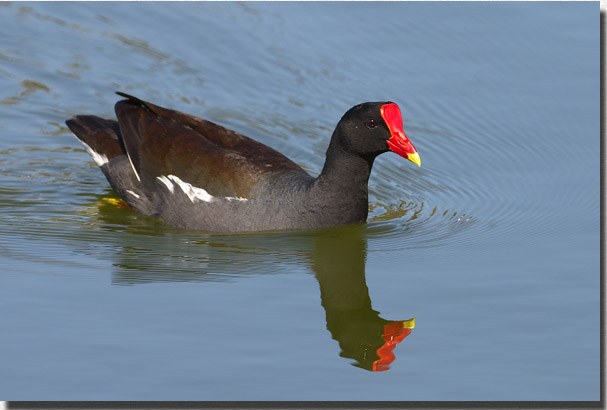
Common Moorhen
- Habitat
- Freshwater marshes and ponds with dense emergent vegetation
- Size
- 12-14 in
- Lifespan
- Banding records suggest individuals can live at least 10-11 years, though precise long-term data for the American population is limited.
- Diet
- Aquatic plants, seeds, insects, and snails
About the Common Moorhen
The Common Moorhen is a medium-sized, chicken-like marsh bird with a slate-gray to blackish body, brownish back, a bright red frontal shield and red-and-yellow bill, a white stripe along the flanks, and a white patch under a tail it flicks frequently while swimming or walking through vegetation, a habit that likely serves as a visual signal to other moorhens nearby.
An important note applies to identification here: the population found in Oklahoma and across the Americas was formally reclassified in 2011 as a separate species, the Common Gallinule (Gallinula galeata), distinct from the true Common Moorhen (Gallinula chloropus) now restricted to Europe, Asia, and Africa; the split was based on differences in vocalizations, bill and shield shape, and genetic data. The American bird, still frequently referred to informally by its older name, occurs locally in Oklahoma in well-vegetated marshes, ponds, and slow streams, generally uncommon and patchily distributed across the state.
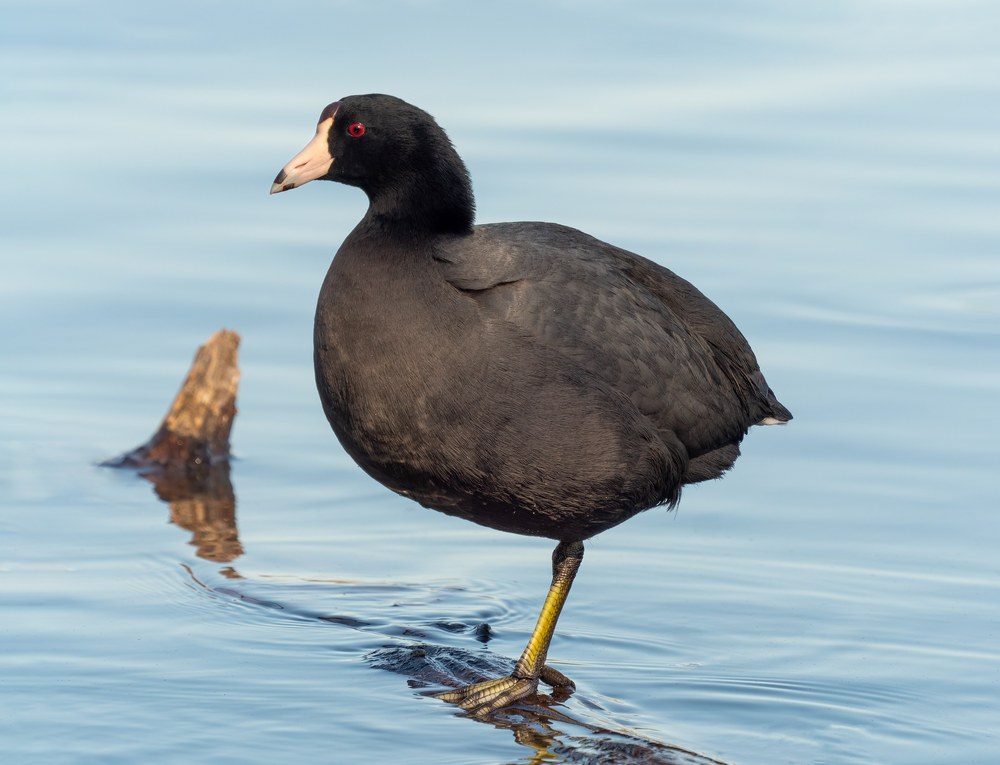
It swims and walks over floating vegetation using long toes that spread its weight, though less broadly than the fully lobed toes of an American Coot, feeding on seeds, aquatic plants, and invertebrates such as snails and insects picked from the water's surface or nearby shoreline vegetation, often bobbing its head forward and back with each swimming stroke.
It builds a floating or emergent-vegetation nest anchored among reeds or cattails, sometimes with a ramp of woven plant material leading up from the water. One genuinely interesting behavior documented in the species is a form of cooperative breeding: both parents, and sometimes older siblings from an earlier brood, help feed and tend later broods of chicks, a pattern of extended family cooperation not typical of most marsh birds. Its loud, clucking, almost chicken-like calls carry well across marshes and are often heard well before the bird itself is spotted moving through dense cover. Chicks are precocial and can swim within hours of hatching, though they remain dependent on the adults for food and protection for several weeks, often seen trailing a parent in a tight line across open water. Despite the recent taxonomic split, most field guides and birdwatchers in Oklahoma continued using the name Common Moorhen informally for years afterward, and the older name still appears frequently in casual conversation and older reference material.
Frequently asked questions
Is the Common Moorhen the same bird found in Oklahoma?
Not exactly; the American population was reclassified in 2011 as the Common Gallinule, a separate species from the true Common Moorhen of the Old World, though the two look very similar.
How can I identify one?
Look for the bright red frontal shield and red-and-yellow bill contrasting with dark slate-gray plumage, plus a white stripe along the flank.
Does it swim like a duck?
It swims readily but also walks well across floating vegetation, using long unwebbed toes rather than the fully lobed toes of a coot.
Do young birds help raise later chicks?
In some cases, yes; older siblings from an earlier brood have been observed helping feed younger chicks later in the same season.
Where to find it
This species favors wetland habitat. See real Oklahoma locations on the Habitats map.