Dark-eyed Junco
- Habitat
- Coniferous and mixed forest for breeding; woodland edges, brushy areas, and backyards in winter
- Size
- 5.5-6.3 in
- Lifespan
- Banding records show individuals living to at least 11 years.
- Diet
- Seeds make up the bulk of the winter diet; insects are more important during the breeding season
About the Dark-eyed Junco
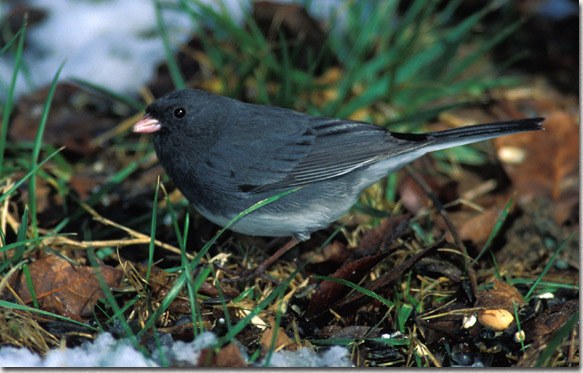
The Dark-eyed Junco is a small, plump sparrow relative with a pink bill and white outer tail feathers that flash conspicuously in flight, a field mark that stands out even on a fast-moving flock. Plumage pattern varies considerably by regional subspecies, several of which were once considered separate species; the 'Slate-colored' form most commonly seen in Oklahoma is uniform slate-gray above with a clean white belly, giving it a hooded appearance, while other forms seen occasionally, such as the pink-flanked 'Oregon' or 'Pink-sided' juncos, show brown backs and warmer flanks that once earned them full species status before all were lumped together under genetic and behavioral study.
It breeds in coniferous and mixed forest across Canada, the northern United States, and higher elevations farther south, including some mountain ranges well south of the US-Canada border. In Oklahoma it's strictly a winter visitor, arriving in fall and departing by spring, common statewide in woodland edges, brushy cover, and backyard feeders, usually in flocks that may include several dozen birds moving together through a neighborhood or woodlot.
Dark-eyed Juncos forage mostly on the ground in loose flocks, hopping and scratching through leaf litter for seeds, and readily visit the ground beneath bird feeders rather than the feeder itself, often cleaning up spilled seed. Farther north during the breeding season, they shift toward insects and other invertebrates, an important protein source for nestlings that isn't as readily available during the winter months spent in Oklahoma.
The species nests on or near the ground, well hidden under a rock, tree root, or grass tussock, far outside Oklahoma's range. Its widely used nickname 'snowbird' reflects the way flocks reliably appear with the onset of cold weather and depart again as spring returns, making it one of the more punctual seasonal arrivals for many backyard birdwatchers. Within a wintering flock, birds establish and maintain a fairly stable dominance hierarchy, generally with adult males ranking above females and younger birds, and studies have found that a junco's position in this pecking order can noticeably affect how much time it spends foraging safely in cover versus more exposed, higher-risk spots.
The species has also served as an important model in behavioral research, since winter flocks maintain a fairly strict, observable dominance hierarchy, often correlated with age and sex, that determines which birds get preferential access to food and favored roosting spots, and long-running studies by researchers such as Ellen Ketterson and Val Nolan on junco hormones and behavior have made it one of the best-studied songbirds in North America. Researchers have also used juncos extensively to study how urbanization affects wildlife, since some populations, particularly in California, have shifted toward breeding in city parks and campuses and evolved subtly different behavior, tamer temperaments, and even slightly different plumage from their forest-breeding counterparts within just a few decades, offering a rare real-time glimpse of a wild bird adapting to city life.
The white outer tail feathers that flash so noticeably in flight are thought to serve a communicative function as well, potentially signaling alarm to flockmates or, in some studies, correlating with an individual's social status within the group. In Oklahoma, juncos typically arrive in force by late October and linger into April, with the exact timing shifting somewhat year to year depending on conditions farther north, and a sudden large arrival of juncos at feeders is often treated by backyard birdwatchers as an informal signal that a stretch of colder weather is on the way. Because of this reliability and its willingness to visit feeders offering millet or mixed seed scattered on the ground, the Dark-eyed Junco ranks among the most frequently reported winter birds in citizen-science feeder surveys across the state.
Frequently asked questions
Why is the Dark-eyed Junco called a 'snowbird'?
It's a common winter visitor across much of the US that reliably arrives with the onset of cold weather, giving it that folk nickname.
Does the Dark-eyed Junco breed in Oklahoma?
No, it breeds much farther north or at higher elevations and is present in the state only as a winter visitor.
What's the easiest way to identify one?
Look for the pink bill, dark hooded head and back, white belly, and flashing white outer tail feathers, especially in flight.
Do juncos have a pecking order in winter flocks?
Yes, research has shown winter flocks maintain a fairly stable dominance hierarchy that affects access to food and preferred perches.
Were the different junco color forms once considered separate species?
Yes, forms such as the 'Oregon' and 'Slate-colored' junco were once classified as distinct species before genetic and behavioral research led to them being lumped into one species, the Dark-eyed Junco.
Where to find it
This species favors forest habitat. See real Oklahoma locations on the Habitats map.