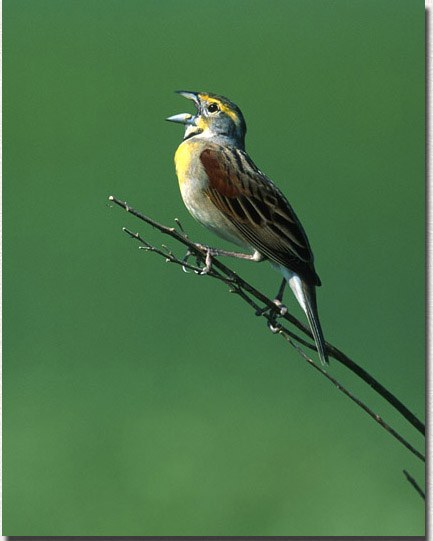
Dickcissel
- Habitat
- Weedy fields and meadows, grain fields, tall-grass prairies, pastures, alfalfa fields; forages on the ground
- Size
- ~6 in; male resembles a miniature meadowlark with a yellow breast, black V, heavy bill, and chestnut wing patch
- Lifespan
- Most survive only 2-4 years; the oldest known banded individual reached almost 9 years.
- Diet
- Young are ~70% grain/grass/forb seeds and the rest insects; adults are reversed, roughly 70% insects and 30% seeds
About the Dickcissel
The male Dickcissel looks like a miniature meadowlark, with a bright yellow breast crossed by a black V, a heavy conical bill suited to cracking seeds, and a chestnut patch on the shoulder. At about 6 inches, it's much smaller than the meadowlark it resembles, and females are considerably plainer, streaked brown overall with only a hint of yellow on the breast, making the sexes easy to tell apart during the breeding season. In fall and winter, when males lose some of their bold breeding pattern, Dickcissels can be mistaken for House Sparrows at a glance, though the heavier bill and hint of yellow on the breast usually help separate them on closer look.
Dickcissels are birds of open grassland and agricultural habitat, found in weedy fields and meadows, grain fields, tall-grass prairies, pastures, and alfalfa fields, foraging mostly on the ground beneath the cover of grass and forbs. One notable quirk of the species is that its breeding distribution shifts erratically from year to year, with birds sometimes abandoning areas that held large numbers the previous season and appearing in force somewhere new, a pattern likely driven by fluctuating habitat quality and food availability across the grasslands it depends on. Some male Dickcissels are also polygynous, attracting and mating with more than one female within a single territory when habitat quality and food are especially good, though many others remain paired with just one mate in a season.
The diet changes dramatically between life stages: nestlings are fed a diet that is roughly 70 percent grain, grass, and forb seeds with the remainder made up of insects, while adults flip that ratio, eating roughly 70 percent insects and only about 30 percent seeds. This reversal reflects the different nutritional demands of rapidly growing chicks versus self-sufficient adults, with adults favoring the more energy-dense insect prey they need to sustain the demands of breeding and migration.
Highly gregarious outside the breeding season, Dickcissels gather into sizable flocks during migration and winter, often mixing with other seed-eating species at feeders or in weedy fields. Males frequently sing from an exposed perch such as a fence post or low tree to declare territory, a persistent, buzzy song that is one of the more recognizable sounds of a summer prairie, and the species readily visits seed feeders when they happen to be near suitable open habitat.
On its wintering grounds in South America, the Dickcissel can gather into enormous communal roosts numbering in the hundreds of thousands of birds, concentrations so large that the species has at times been regarded as an agricultural nuisance in grain-growing regions there, occasionally prompting large-scale control efforts that have themselves raised conservation concerns given how much of the entire global population can be concentrated in relatively few roost sites at once. Combined with widespread loss of native grassland breeding habitat across much of the Great Plains and Midwest, this concentration on the wintering grounds has made the Dickcissel a species of ongoing conservation interest despite still being locally abundant in good grassland habitat during the North American summer.
In Oklahoma, the species is best looked for in tallgrass prairie remnants, hayfields, and weedy roadside margins from late spring through summer, with singing males often the easiest way to confirm its presence in a given patch of grassland since females and nonbreeding birds are far less conspicuous. Conservation programs that encourage delayed mowing or rotational grazing on private grasslands have been shown to modestly improve nesting success for Dickcissels and other grassland songbirds sharing the same habitat, since a nest built low in standing hay or grass is easily destroyed by an early summer cut timed for livestock feed rather than for wildlife.
Frequently asked questions
Why does the male Dickcissel look like a small meadowlark?
Both species share a similar yellow breast and black V marking, though the Dickcissel is considerably smaller with a heavier, seed-cracking bill.
Why do Dickcissel populations shift location from year to year?
Their breeding distribution is erratic, likely responding to changing habitat quality and food availability across the grasslands they use.
How does a young Dickcissel's diet differ from an adult's?
Nestlings eat mostly seeds and grain with some insects, while adults reverse that pattern, eating mostly insects with fewer seeds.
Are Dickcissels social birds?
Yes, they're highly gregarious outside the breeding season, forming large flocks during migration and winter.
Do male Dickcissels mate with more than one female?
Some do -- in good-quality habitat with ample food, a male may attract and mate with several females on his territory, though many others pair with just one mate per season.
Where to find it
This species favors grassland habitat. See real Oklahoma locations on the Habitats map.