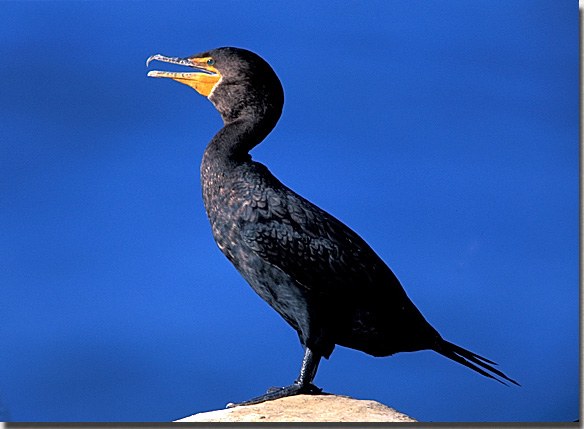
Double-crested Cormorant
- Habitat
- Lakes, rivers, reservoirs, and coastal waters
- Size
- 28-35 in
- Lifespan
- Banding records show individuals living to around 22 years.
- Diet
- Primarily fish, caught through underwater pursuit diving
About the Double-crested Cormorant
The Double-crested Cormorant is a large, dark waterbird with a long hooked bill, an orange-yellow throat pouch, and a long, snake-like neck often held in a distinctive kinked posture in flight. Breeding adults briefly grow small feathery double crests, dark or whitish depending on the population, that give the species its name, though they're subtle and easy to overlook in the field except at close range during the early breeding season. Its striking turquoise-green eye color is another feature often missed at a distance but readily visible in a close view or through binoculars.
It's common and widespread across Oklahoma on lakes, reservoirs, and rivers, present year-round in many areas with numbers increasing during migration and winter as northern-breeding birds move through or settle in for the colder months. It's frequently seen perched upright on snags, docks, buoys, or powerlines with its wings spread open to dry, a posture that has become an iconic image of the species.
The species pursues fish underwater using powerful webbed feet for propulsion rather than its wings, often diving repeatedly in the same productive area and sometimes foraging cooperatively in loose groups that appear to herd fish. Because its feathers are less water-repellent than most waterbirds, it must periodically come ashore to spread its wings and dry off, one of its most recognizable behaviors and a useful identification cue even at a distance. This reduced buoyancy also means the cormorant rides noticeably lower in the water than ducks, geese, or grebes, often with just the head, neck, and a sliver of back showing above the surface, another handy field mark at long range.
It nests colonially in trees or on the ground on islands, often alongside herons and egrets, building stick nests that can become quite large and conspicuous over repeated years of use. Heavy, sustained nesting activity at a colony can eventually kill the very trees the birds depend on, through a combination of accumulated droppings and physical damage from repeated nest building, sometimes forcing a colony to relocate to a fresh site after some years of use.
The partially wettable plumage that requires this drying behavior actually reduces the bird's buoyancy, which in turn helps it dive more efficiently and stay submerged with less effort than a fully waterproofed diving bird, a genuine trade-off that favors its pursuit-diving fishing style over the sit-and-wait or surface-feeding strategies used by many other waterbirds. The species was once heavily persecuted around fish hatcheries and aquaculture operations due to concerns over competition for fish, and suffered further steep declines in the mid-20th century from DDT and other pesticide contamination that thinned eggshells much as it did for eagles and pelicans; though conflicts still arise locally, its populations have generally rebounded well across most of North America since the pesticide ban and more protective regulations took hold in the later 20th century. In some regions, growing cormorant numbers have themselves become a management concern for fisheries and for the vegetation at heavily used colony sites, illustrating how conservation success for one species can create new balancing challenges for wildlife managers.
Five subspecies of Double-crested Cormorant are recognized across North America, differing subtly in size, bill shape, and the color of the breeding crests, with the widespread interior form found in Oklahoma generally showing dark crests compared to the whiter crests of some coastal populations farther west. Migratory flocks are often seen flying in loose lines or Vs, sometimes mixed with other waterbirds, and large numbers can stage on reservoirs during spring and fall passage before continuing on, making certain lakes temporarily hold impressive concentrations of the species well beyond the modest numbers present at other times of year.
Frequently asked questions
Why does the Double-crested Cormorant spread its wings out in the sun?
Its feathers are less waterproof than most waterbirds, so it needs to air- and sun-dry them after diving to stay properly insulated and able to fly efficiently.
Where does its name come from?
Breeding adults grow small feathery crests, often dark or white depending on the population, though they're subtle and easy to miss in the field.
Is the Double-crested Cormorant present in Oklahoma year-round?
Yes, in many parts of the state it can be found throughout the year, with numbers often higher during migration and winter.
Why are its feathers not fully waterproof?
The reduced water-repellency helps the bird sink and dive more efficiently, an adaptation suited to its pursuit-diving fishing strategy.
Did pesticides ever affect Double-crested Cormorant populations?
Yes, DDT contamination thinned their eggshells and caused steep declines in the mid-20th century, similar to its effects on Bald Eagles, before the pesticide ban helped populations recover.
Where to find it
This species favors wetland habitat. See real Oklahoma locations on the Habitats map.