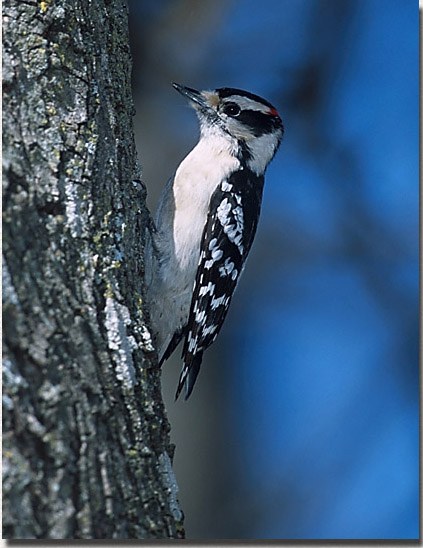
Downy Woodpecker
- Habitat
- Deciduous/mixed forests, small woodlots, suburbs, orchards, gardens, urban areas; in the west, often in willow/poplar along streams
- Size
- 6 in, sparrow-sized woodpecker
- Lifespan
- Typically lives 2-5 years, though the oldest documented banded bird reached almost 12 years.
- Diet
- Insects (75–85%); also fruit, seeds, and sap from sapsucker holes
About the Downy Woodpecker
The Downy Woodpecker is North America's smallest woodpecker, a sparrow-sized bird about 6 inches long with a black-and-white checkered pattern, a white back stripe, and a short, stubby bill that is notably shorter relative to head size than that of the very similar-looking Hairy Woodpecker. Males show a small red patch on the back of the head that females lack, and despite the strong resemblance between the two species, genetic studies have shown the Downy is actually more closely related to the Ladder-backed Woodpecker of the arid Southwest than to the Hairy Woodpecker it so closely mimics in pattern.
This adaptable woodpecker occupies deciduous and mixed forests, small woodlots, suburban yards, orchards, gardens, and urban parks, and in the western part of its range it is frequently found along streams lined with willow and poplar. Its tolerance for small, fragmented patches of trees, unlike many woodpeckers that need larger forest tracts, has let it thrive in suburban and even urban settings where other woodpecker species are largely absent.
Insects make up 75 to 85 percent of the Downy's diet, gleaned and excavated from bark and dead wood, supplemented by fruit, seeds, and sap taken opportunistically from holes drilled by sapsuckers. One particularly well-documented foraging habit is the Downy's fondness for excavating the round galls found on goldenrod stems in fall and winter, chiseling out the fly larva developing inside, a food source available through the leanest months when other insects are scarce. Its small size lets it forage in ways many woodpeckers cannot, including hanging from thin outer branches and even clinging to plant stems and leaves in a manner more reminiscent of a chickadee than a typical bark-foraging woodpecker, opening up food sources on slender twigs that larger woodpeckers can't reach.
Downy Woodpeckers are enthusiastic and frequent visitors to backyard feeders, particularly suet, making them one of the most commonly observed woodpeckers by casual birdwatchers. Most individuals live only 2 to 5 years in the wild, though banding records show the species is capable of considerably more longevity, with the oldest documented bird reaching nearly 12 years, a testament to how much individual variation exists beneath a modest average lifespan.
Downy Woodpeckers also drum rapidly on resonant dead branches, gutters, or other objects as a form of long-distance communication, a steady, even pattern distinct from the more irregular tapping used while excavating for food, and pairs will sometimes drum back and forth to each other in a simple duet during the early breeding season. The species excavates a fresh nest cavity each year in a dead or dying tree, usually completed by both parents over one to two weeks, and cavities from previous years are frequently reused afterward by chickadees, wrens, or other small cavity-nesting birds unable to excavate their own, making the Downy Woodpecker a quietly important source of nest sites for the wider woodland bird community. Male and female Downy Woodpeckers also show a modest difference in foraging location, with males more often working smaller branches and twigs higher in a tree while females spend more time on the trunk and larger limbs, a subtle partitioning that likely reduces direct competition between mates sharing the same territory.
The species is nonmigratory across virtually its entire range, including Oklahoma, so the same individuals typically remain on or near a home territory throughout the year, joining loose winter foraging flocks with chickadees and titmice rather than departing for a separate wintering ground the way many songbirds do. This year-round residency, combined with its comfort around people and willingness to nest in ordinary suburban trees, makes the Downy Woodpecker one of the most dependable woodpeckers for casual backyard observation anywhere within its wide North American range.
Frequently asked questions
How can you tell a Downy Woodpecker from a Hairy Woodpecker?
The Downy is smaller with a notably shorter bill relative to its head size, despite both species sharing a very similar black-and-white pattern.
Is the Downy Woodpecker closely related to the Hairy Woodpecker?
Surprisingly, no -- genetic studies show it's more closely related to the Ladder-backed Woodpecker despite looking so much like the Hairy Woodpecker.
What makes the Downy Woodpecker able to forage on thin branches?
Its small size lets it hang from slender twigs and even cling to plant stems, a foraging style more typical of chickadees than most woodpeckers.
Do Downy Woodpeckers visit backyard feeders?
Yes, they're frequent and enthusiastic visitors, especially to suet feeders.
Do Downy Woodpeckers reuse their nest holes?
Not usually themselves -- they typically excavate a new cavity each year, but old cavities are frequently taken over afterward by chickadees, wrens, and other small birds that cannot excavate their own.
Where to find it
This species favors forest habitat. See real Oklahoma locations on the Habitats map.