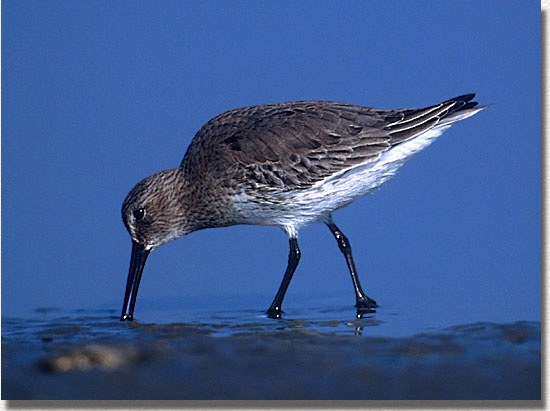
Dunlin
- Habitat
- Breeds on Arctic tundra; migrates and winters on coastal mudflats, shorelines, and inland wetlands
- Size
- 7-8.5 in
- Lifespan
- A banding record from California documented an individual living at least 12 years, 5 months, well above the species' typical lifespan.
- Diet
- Small invertebrates such as worms, small crustaceans, and mollusks, probed from mud or sand
About the Dunlin
The Dunlin is a medium-sized sandpiper with a build slightly stockier than many similarly sized shorebirds. Breeding adults show a distinctive black belly patch, reddish-brown back, and a bill with a slightly downcurved tip, a combination not shared by most other North American sandpipers in that plumage. In the plainer non-breeding plumage typically seen in Oklahoma, it appears gray-brown above and white below, with the drooping bill tip remaining a useful field mark when the more distinctive breeding pattern is absent.
It breeds on Arctic tundra in the far north of North America, Europe, and Asia. In Oklahoma the Dunlin occurs as a migrant, most often seen at wetlands, lake margins, and mudflats during spring and fall passage between its Arctic breeding grounds and wintering areas along the Gulf Coast and elsewhere, generally in modest numbers compared to the huge coastal concentrations seen at major shorebird staging areas.
Dunlins forage by probing their bill rapidly into soft mud or wet sand, a motion often described as resembling a sewing machine, in search of worms, small crustaceans, and mollusks just below the surface. They frequently forage and roost in dense, tightly packed flocks alongside other shorebirds, taking advantage of many eyes watching for approaching predators.
The species nests in a simple ground scrape on tundra, with incubation duties shared between the sexes depending on the population, though in some populations the male takes on a larger share of chick-rearing after the eggs hatch. One of its most striking behaviors is seen during migration and winter, when Dunlin flocks form some of the largest and most tightly coordinated shorebird gatherings in the world, wheeling and turning in unison in dense, shimmering formations that shift direction almost instantaneously, an anti-predator behavior thought to confuse attacking falcons by making it difficult for a predator to single out one bird from the mass. Outside the breeding season Dunlins are highly gregarious, often roosting in dense clusters at high tide on exposed sandbars or levees, packed shoulder to shoulder until the tide recedes and feeding grounds are exposed again. The Dunlin is also one of the most intensively studied shorebirds in the world, serving as a model species for research into shorebird migration timing, stopover ecology, and the effects of wetland habitat loss along major flyways.
Frequently asked questions
When is the best time to see a Dunlin in Oklahoma?
During spring and fall migration, when the birds pass through en route between Arctic breeding grounds and wintering coastal areas.
How do I identify a Dunlin?
Look for its slightly drooping bill tip, plain grayish-brown winter plumage, and habit of foraging in tight flocks with rapid, repeated probing into mud.
Why do Dunlin flocks wheel and turn together in the air?
The tightly synchronized flight is thought to help confuse predators, such as falcons, attempting to single out an individual bird.
Where does the Dunlin breed?
On Arctic tundra in the far north of North America, Europe, and Asia, far from migratory stopover sites like Oklahoma.
Where to find it
This species favors wetland habitat. See real Oklahoma locations on the Habitats map.