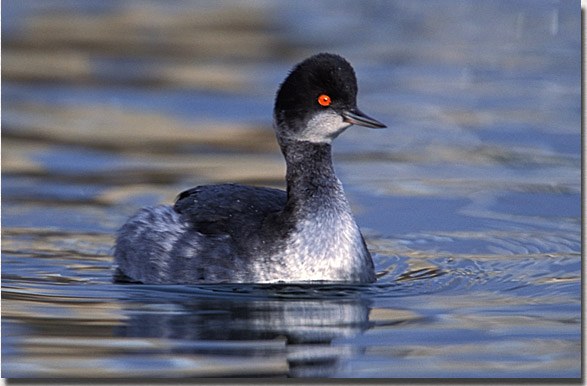
Eared Grebe
- Habitat
- Shallow saline or alkaline lakes for breeding and staging; migrant on inland lakes and reservoirs elsewhere
- Size
- 12-14 in
- Lifespan
- Reliable long-term data are limited; one banding record documented a bird living at least 8-9 years, but a confident typical-lifespan figure isn't well established for this species.
- Diet
- Aquatic invertebrates, especially brine shrimp and brine flies where available, plus other small aquatic insects
About the Eared Grebe
The Eared Grebe is a small grebe with a peaked black head, a thin, slightly upturned-looking bill, and striking golden 'ear' tufts fanning out behind red eyes in breeding plumage, giving it a somewhat wild, spiky-headed appearance during the summer months. Non-breeding birds, more likely to be seen passing through Oklahoma, are duller gray-and-white with a smudgy dark cheek patch and lack the ornamental head feathers entirely.
It's considered the most abundant grebe in North America overall, with enormous concentrations, sometimes numbering in the hundreds of thousands, gathering at a handful of hypersaline lakes, such as the Great Salt Lake and Mono Lake, during migration. In Oklahoma it occurs primarily as a migrant on lakes and reservoirs, typically in much smaller numbers than at its famous staging sites farther west, and is easy to overlook among more numerous waterfowl.
Eared Grebes dive and glean from the water's surface for small aquatic invertebrates, propelling themselves with lobed toes rather than fully webbed feet. During major staging events at its key lakes, it feeds intensively on brine shrimp and brine flies, building substantial fat reserves, sometimes nearly doubling its body weight, before continuing its migration in a series of long nonstop flights.
The species nests colonially on floating vegetation over shallow alkaline lakes, sometimes in colonies of thousands of pairs. Genuinely remarkable is the extreme physiological transformation the species undergoes before long migratory flights: it temporarily shrinks its own flight muscles, heart, and digestive organs during a flightless staging period that can last weeks, then rapidly regrows the flight muscles and digestive organs afterward in preparation for departure, all while briefly becoming entirely unable to fly, one of the most dramatic body changes documented in any bird and a striking example of how tightly migratory physiology can be tuned to a species' ecological strategy. Because of this extended flightless period, Eared Grebes are especially vulnerable to sudden die-offs if a hypersaline lake freezes early or food supplies collapse unexpectedly, and large mortality events have occasionally been documented at major staging lakes as a result. Its dependence on just a small handful of critical staging lakes across the entire continent means that habitat or water-quality problems at any one of those sites can have an outsized effect on the overall North American population.
Frequently asked questions
Is the Eared Grebe common in Oklahoma?
It occurs mainly as a migrant, usually in far smaller numbers than at its famous staging lakes farther west, such as the Great Salt Lake.
What's unusual about its body during migration prep?
It undergoes dramatic internal changes, shrinking flight muscles and organs while fattening up, then regrows flight muscles before migrating, an extreme transformation among birds.
What does it eat at its main staging lakes?
Primarily brine shrimp and brine flies, which are extraordinarily abundant at hypersaline lakes like the Great Salt Lake and Mono Lake.
How do I tell it from other grebes?
Breeding birds have distinctive golden ear tufts and a peaked black head; non-breeding birds are grayer and less sharply marked than a Horned Grebe.
Where to find it
This species favors wetland habitat. See real Oklahoma locations on the Habitats map.