European Starling
- Habitat
- A wide variety of habitats across virtually all of the continental US and southern Canada
- Size
- 7½–8½ in, smaller than a robin, short-tailed
- Lifespan
- Averages 2-5 years in the wild; the oldest North American banded bird reached over 15 years.
- Diet
- Fruit, seeds, invertebrates, berries
About the European Starling
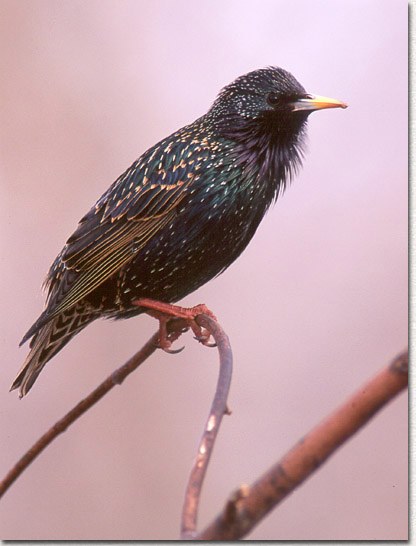
The European Starling is a stocky, short-tailed songbird measuring 7.5 to 8.5 inches, noticeably smaller and more compact than an American Robin despite its confident, almost swaggering presence around people. In breeding plumage the body glows with an iridescent sheen of purple and green over black, set off by a long, sharply pointed yellow bill. By winter the same feathers become heavily flecked with white spots, giving the bird a speckled, frosted appearance that fades again as the pale tips wear away by spring. The bill, too, changes with the season, turning duskier in winter before brightening back to yellow as breeding approaches.
Originally native to Europe, the species now occupies a huge range across virtually the entire continental United States and southern Canada, a spread traceable to a small number of birds released in New York's Central Park in the 1890s by a group with a fondness for introducing every bird species mentioned in the works of Shakespeare to North America; of the roughly one hundred species released as part of that effort, the starling was one of only a very few that took hold and thrived. Starlings thrive in an enormous variety of habitats, from farmland and city parks to suburban yards and roadsides, largely because they are so unfussy about where they feed, roost, and nest. Their success has come at a real ecological cost: because they nest in cavities, they compete aggressively with native cavity-nesters such as bluebirds and woodpeckers, frequently winning contests for a limited supply of nest holes.
Foraging starlings feed on a broad mix of fruit, seeds, berries, and invertebrates, often probing open ground with that long bill in a distinctive open-and-close motion known as "open-bill probing" that lets them see and grab insects hidden just beneath the surface, a foraging technique aided by unusually strong jaw muscles for opening the bill against resistance in packed soil. Outside the breeding season they gather into large, tightly coordinated flocks, sometimes numbering in the thousands to hundreds of thousands at major winter roosts, that wheel and pulse through the sky in dense, shifting formations known as murmurations before dropping suddenly onto a roost, a spectacle thought to help confuse predators and share roost-site information among flock members.
One of the species' more entertaining traits is vocal mimicry: individual starlings can incorporate the calls and songs of other birds, and even mechanical sounds such as car alarms or ringtones, into their own chattering, warbling repertoire, a skill put to famous use when starlings owned by naturalist enthusiasts were even taught to mimic short phrases of human speech. Combined with their gregarious flocking behavior and adaptability to nearly any human-altered landscape, this vocal flexibility has helped the European Starling become one of the most numerous and widespread birds in North America, for better or worse, with huge winter roosts near agricultural areas sometimes drawing organized control efforts due to crop damage and the sheer volume of droppings they can leave behind.
Starlings are also strong, fast fliers capable of holding tight formation at speed, a skill that serves them well both in evading airborne predators such as falcons during a murmuration and in the long, direct commuting flights many populations make daily between a roost and distant feeding grounds. Breeding pairs typically raise two broods in a season where conditions allow, taking over a natural cavity or, just as often, an artificial one such as a vent, streetlight housing, or building crevice, reflecting the same opportunistic adaptability that has served the species so well since its arrival in North America.
Frequently asked questions
How can I tell a European Starling from a similar dark bird?
Look for a short tail, chunky body, and long pointed yellow bill, with an iridescent black body in summer that turns white-speckled in winter.
Are European Starlings native to North America?
No, they were introduced from Europe and have since spread across almost all of the continental US and southern Canada.
Do starlings compete with native birds?
Yes, they compete aggressively for nest cavities with native species, often outcompeting them for limited nesting sites.
Can European Starlings imitate sounds?
Yes, they are skilled mimics known for incorporating the songs and calls of other bird species, and even mechanical sounds, into their own vocalizations.
Why were European Starlings brought to North America in the first place?
A small number were released in New York's Central Park in the 1890s as part of an effort to introduce birds mentioned in Shakespeare's works; the starling was one of the few species from that effort to survive and spread.