Ringed Turtle Dove
- Habitat
- Not a wild native bird — a domesticated cagebird and dovecote breed; small feral colonies persist in a few mild-climate US locations, most notably near Los Angeles and in southern Florida
- Size
- 11-13 inches (28-32 cm)
- Lifespan
- Captive birds commonly live 10-15 years and some reach into their 20s in well-cared-for conditions. Because it is not a self-sustaining wild species, there is no reliable longevity data for genuinely feral or wild individuals.
- Diet
- Seed and grain mixes provided in captivity; feral individuals forage on available seeds and scattered grain
About the Ringed Turtle Dove
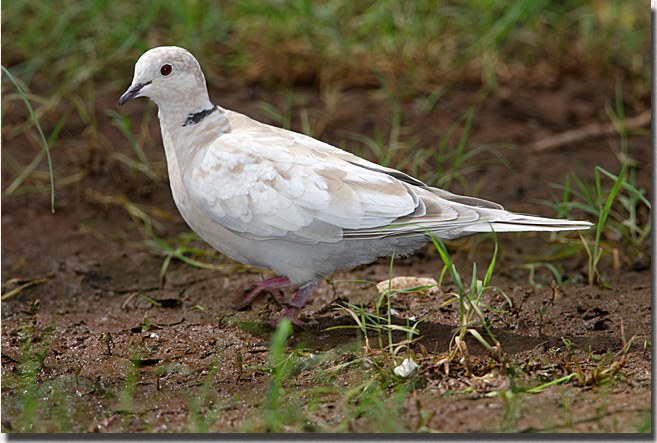
The Ringed Turtle Dove has pale, fairly uniform buffy-fawn plumage, distinctly paler than most wild doves, with a neat black crescent, or half-collar, across the back of the neck that gives the bird its name. In overall shape it resembles the Eurasian Collared-Dove now common across Oklahoma, but Ringed Turtle Doves are smaller, paler (some individuals bred toward cream or near-white), and, importantly, not established as a genuine wild population anywhere in the state.
This is the domesticated form of the African Collared-Dove, selectively bred in captivity for perhaps 2,000 to 3,000 years. It has long been prized as a docile aviary and dovecote bird and was historically released at weddings and other ceremonies. Escaped or deliberately released birds have founded small, localized feral colonies in a handful of consistently mild parts of the United States, but these birds generally lack the instincts to find natural food sources, evade predators, or survive harsh winters, so such colonies tend to stay small rather than spread. Any Ringed Turtle Dove reported in Oklahoma should be treated as an escaped or released captive bird rather than evidence of an established wild population, since the state's winters work against long-term survival.
The species is entirely graminivorous, eating a mix of seeds and grains; in captivity it is typically fed commercial dove or pigeon seed blends. It is gentle and social, often kept in mixed aviaries, and known for a soft, repeated three-note cooing call rather than any elaborate song. In the pet and aviculture trade it is also frequently sold under the name "Barbary Dove," and breeders have produced a range of color variations beyond the classic pale fawn, including white birds commonly released at outdoor weddings and memorial events.
Pairs bond readily and breed prolifically in captivity, often nearly year-round if conditions allow, laying a small clutch of two white eggs that both parents incubate and later feed with crop milk, as other pigeons and doves do. This ease of breeding in captivity is part of why the species has been propagated worldwide as a pet and exhibition bird for so long, even though — unlike its wild ancestor, the African Collared-Dove — it can no longer reliably survive on its own outside human care.
Frequently asked questions
Is the Ringed Turtle Dove a wild bird?
No — it is the domesticated form of the African Collared-Dove, bred in captivity for millennia as a pet and dovecote bird.
Could I actually see one in Oklahoma?
Only rarely, as an escaped or released captive bird; Oklahoma has no known established wild population of this species.
How is it different from the Eurasian Collared-Dove seen across Oklahoma?
The Eurasian Collared-Dove is a genuinely wild, self-sustaining species that has spread across the state; the Ringed Turtle Dove is paler, smaller, and persists only where people maintain or repeatedly release it.
How long do Ringed Turtle Doves live?
Well cared-for captive birds commonly reach 10-15 years, with some individuals living considerably longer.