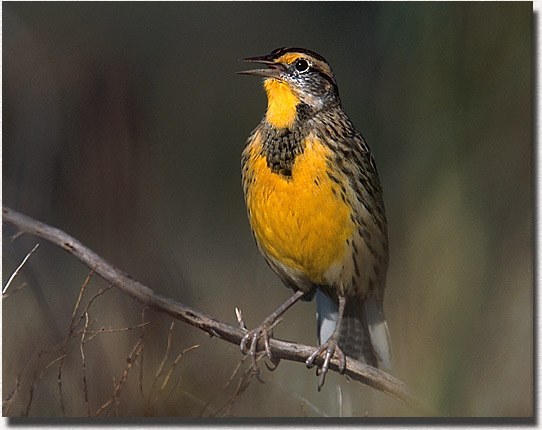
Eastern Meadowlark
- Habitat
- Pastures, meadows, grassy fields, prairies, open country, country roadsides; prefers moister habitat than the Western Meadowlark
- Size
- 8½–11 in
- Lifespan
- Average lifespan is roughly 5 years; the oldest well-documented banded bird reached about 9 years.
- Diet
- Spiders, grass and forb seeds, fruit
About the Eastern Meadowlark
The Eastern Meadowlark is a chunky, short-tailed grassland songbird, 8.5 to 11 inches long, with a bright yellow breast crossed by a bold black V, brown-and-black mottled upperparts that provide excellent camouflage in tall grass, and white outer tail feathers flashed conspicuously in flight. It looks almost identical to the closely related Western Meadowlark, and the two are most reliably told apart by voice rather than plumage, since the visual differences between them are subtle; in areas where their ranges overlap, birds are known to occasionally hold territory next to one another with essentially no interbreeding, a striking example of how learned song alone can maintain separation between two very similar species.
This species favors pastures, meadows, grassy fields, prairies, and open country generally, along with country roadsides, and it tends to prefer moister grassland habitat than the Western Meadowlark, which leans toward drier, more arid terrain. This subtle habitat partitioning helps explain how the two nearly identical species can coexist across overlapping portions of their ranges without directly competing for the same nesting sites. Some males are mildly polygynous, mating with more than one female within a single territory in a good year, though the degree of this varies across the species' range and from season to season depending on habitat quality.
The Eastern Meadowlark forages primarily on the ground, taking spiders along with grass and forb seeds and a modest amount of fruit, probing into soil and grass litter with its sharply pointed bill in a manner well suited to extracting invertebrates hidden below the surface. In flight, the species has a distinctive stiff-winged, fluttering flight style interspersed with short glides, quite different from the flight of most other grassland songbirds and often a useful identification cue at a distance even before plumage details can be seen clearly.
One of the best-known sounds of open farmland, the Eastern Meadowlark's clear, flutelike song is delivered from a fence post or utility wire, often the only visible perch for some distance across open grassland. Outside the breeding season, meadowlarks form relatively small, tightly cohesive winter flocks, and in areas where their ranges overlap, Eastern and Western Meadowlarks will often mix together within the same winter flock despite otherwise avoiding interbreeding due to differences in song and habitat preference.
Rather than building an open cup nest, the Eastern Meadowlark constructs a well-hidden, domed structure on the ground, weaving standing grass overhead into a woven roof that conceals the nest chamber from above, sometimes with a short entrance tunnel running through the surrounding vegetation. This elaborate concealment offers real protection from aerial predators and grassland fires alike, though it leaves eggs and flightless young vulnerable to ground-based predators such as snakes and skunks, and to disturbance from mowing or grazing in the same pastures the species depends on for cover. Populations have declined across much of the farm belt in recent decades as haying and mowing schedules increasingly overlap with the nesting period, and conservation groups have promoted delayed-mowing and rotational grazing programs on private grassland as one practical way to improve nest survival for this and other declining grassland birds sharing the same habitat.
In Oklahoma, the species remains a familiar and widespread sight across the state's pastures and roadsides year-round, since many local birds are permanent residents rather than migrants, though numbers can shift somewhat with the arrival of birds from farther north in winter. Its clear, whistled song, often rendered as sounding like "spring-of-the-year," is one of the most recognizable and cherished sounds of the Oklahoma countryside, and a singing male perched on a fence post remains one of the simplest and most reliable ways to enjoy the species even without close binocular views.
Frequently asked questions
How do you tell an Eastern Meadowlark from a Western Meadowlark?
The two look nearly identical, so voice is the most reliable way to distinguish them rather than plumage.
Where does the Eastern Meadowlark prefer to nest compared to the Western Meadowlark?
It favors moister grassland habitat, while the Western Meadowlark tends toward drier, more arid terrain.
What does the Eastern Meadowlark eat?
Mostly spiders along with grass and forb seeds, foraged on the ground, plus a modest amount of fruit.
Do Eastern and Western Meadowlarks ever flock together?
Yes, in winter they often mix within the same cohesive flocks even though they don't typically interbreed.
Why have Eastern Meadowlark populations declined in farm country?
Modern haying and mowing schedules increasingly overlap with the nesting period, destroying ground nests, which has driven declines across much of the farm belt in recent decades.
Where to find it
This species favors grassland habitat. See real Oklahoma locations on the Habitats map.