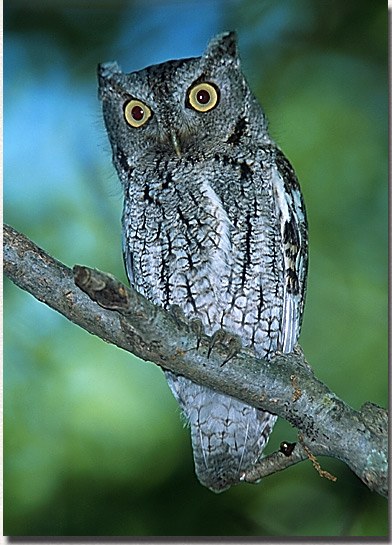
Eastern Screech Owl
- Habitat
- Open woodlands, deciduous forests, parks, farms, riparian groves, swamps, old orchards, small woodlots, suburban areas
- Size
- 10 in
- Lifespan
- Wild birds often live 3-7 years, though the oldest documented individual reached over 14 years.
- Diet
- Mostly small vertebrates — small mammals and birds
About the Eastern Screech Owl
The Eastern Screech Owl is a small, compact owl about 10 inches tall, with mottled, bark-like plumage that occurs in two distinct color morphs — an overall gray form and a rufous, or reddish-brown, form — both patterned to blend seamlessly with tree bark. Prominent ear tufts, which are simply feathers and have nothing to do with actual hearing, can be raised into sharp points or flattened down depending on the bird's mood, and piercing yellow eyes complete a face built for low-light hunting.
This adaptable little owl occupies open woodlands, deciduous forests, parks, farms, riparian groves, swamps, old orchards, small woodlots, and suburban neighborhoods with mature trees, and its tolerance for human-altered landscapes has made it one of the more commonly encountered owls even in populated parts of Oklahoma, provided suitable tree cavities for roosting and nesting are available.
Small vertebrates dominate the diet, chiefly small mammals such as mice and voles along with small birds, taken through quiet, low-level flight and sudden ambush from a perch, an approach aided by feathers specially structured to muffle the sound of flight. Its plumage's bark-like camouflage doubles as protection during the day, when the owl often roosts in a tree cavity or against a trunk, effectively invisible to passersby.
Strictly nocturnal, the Eastern Screech Owl becomes almost entirely inactive during daylight hours, and if discovered roosting in the open, it will freeze bolt upright with its plumage compressed, relying entirely on camouflage rather than flight to avoid detection. Despite its small size, the species is fearless and combative in defense of its nest, with documented cases of screech owls striking people who venture too close to a nest cavity, a startling display of aggression from a bird that spends most of its life trying to remain unseen. Eastern Screech Owls nest in cavities rather than building nests of their own, relying on old woodpecker excavations, natural tree hollows, and readily accepting nest boxes placed in suitable wooded or suburban settings. Its vocal repertoire is distinctive and, despite the name, does not actually include a scream: the two main calls are a descending, whinnying trill and a longer, even-pitched trill, both used to communicate between mates and to declare territory to neighboring owls after dark.
Frequently asked questions
What are the two color forms of the Eastern Screech Owl?
It occurs in a gray morph and a rufous (reddish-brown) morph, both patterned to resemble tree bark.
Do the ear tufts on a screech owl help it hear better?
No, the tufts are just feathers used for camouflage and mood display, unrelated to actual hearing.
What does an Eastern Screech Owl do if found in daylight?
It typically freezes upright, relying on its bark-like camouflage rather than flight to avoid being noticed.
Is the Eastern Screech Owl dangerous to approach near its nest?
It can be surprisingly aggressive, with documented cases of the owl striking humans who get too close to a nest cavity.
Where to find it
This species favors forest habitat. See real Oklahoma locations on the Habitats map.