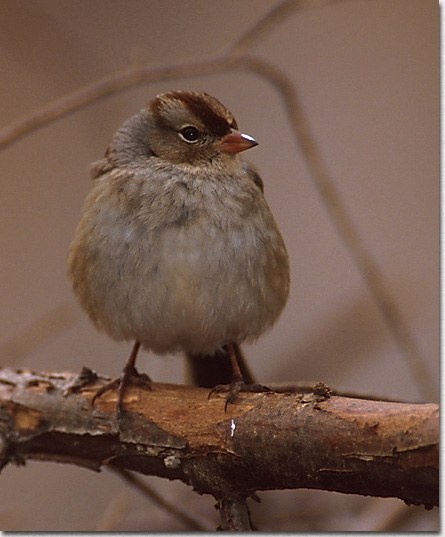
Field Sparrow
- Habitat
- Overgrown fields, shrubby pastures, and edges with scattered small trees or shrubs
- Size
- 5-5.75 in
- Lifespan
- Banding records show individuals living to at least 10 years.
- Diet
- Seeds for most of the year, with insects added during the breeding season
About the Field Sparrow
The Field Sparrow is a small, slim sparrow with a plain, unstreaked buffy-gray breast, a rufous cap, a distinctive pink bill, and a white eyering that gives it a gentle, plain-faced expression compared to more boldly patterned sparrows such as the Song or Savannah Sparrow. Its overall soft coloring and lack of strong markings can make it easy to overlook in a mixed sparrow flock at first glance, and the pink bill is one of the most reliable marks separating it from the similarly capped Chipping Sparrow, which shows a dark bill and a black eyeline the Field Sparrow lacks. Juveniles wear a finely streaked breast for their first few weeks out of the nest, gradually molting into the clean, unmarked adult plumage by late summer, so a streaky young bird in a weedy field in July is often simply a Field Sparrow still finishing its post-juvenile molt rather than a different species entirely.
It's a common breeder across Oklahoma in overgrown pastures, old fields transitioning back to shrubland, and other early-successional habitat with a mix of grass, forbs, and scattered woody cover, similar in some ways to habitat favored by Bobwhite and Blue-winged Warbler. Some birds remain through winter in the southern part of the range, while others move farther south, often joining mixed flocks of sparrows in weedy fields. Populations across the eastern part of the range tend to show slightly warmer, more rufous tones than birds farther west on the Great Plains, a mild geographic variation that has led some ornithologists to recognize separate subspecies groups, though the differences are subtle enough that most birders simply note them as one widespread, familiar species.
Field Sparrows forage low in vegetation or on the ground for grass and weed seeds most of the year, shifting toward insects and other invertebrates during the breeding season to meet the nutritional needs of nestlings, a seasonal dietary shift shared with many other sparrow species. Outside the breeding season they often join loose foraging flocks with juncos, other sparrows, and bluebirds moving through the same brushy fields, an arrangement that likely offers extra eyes for spotting predators as well as easier relocation of productive feeding patches.
The species builds a well-hidden cup nest on or near the ground early in the season, often moving nests higher into shrubs later as vegetation grows denser and ground-nest predation risk changes over the course of the summer. Pairs commonly raise two, and sometimes three, broods across a single breeding season, re-nesting quickly after a successful fledging or a failed attempt, which helps offset the substantial losses many ground- and shrub-nesting songbirds suffer to snakes, small mammals, and brood-parasitizing cowbirds. Its song is famous among birders as a sweet, clear series of whistled notes that accelerates into a rapid trill, often likened to the sound of a bouncing ball coming to rest, making it one of the more musical and easily learned sparrow songs and a favorite among people first learning to identify birds by ear.
Field Sparrow numbers have declined across much of the species' range in recent decades as overgrown, shrubby fields have become scarcer, converted either to intensive agriculture on one end or to mature closed-canopy forest on the other, squeezing out the in-between habitat it needs. Long-term survey data compiled by groups such as Partners in Flight place the Field Sparrow among the more steadily declining grassland-associated songbirds in North America, a trend serious enough that the species now appears on several regional conservation watch lists. Because of this, the Field Sparrow is often cited by conservationists as a useful indicator species for the health of shrubland and early-successional habitat generally, a category that supports many other declining grassland and edge-dependent birds as well, from Bell's Vireo to the Prairie Warbler.
Frequently asked questions
What does a Field Sparrow's song sound like?
A series of clear, sweet whistles that speed up into a trill, often compared to the sound of a bouncing ball settling to a stop.
How do I identify a Field Sparrow?
Look for its plain gray face, rufous cap, pink bill, and clean unstreaked breast, fairly plain compared to many other sparrows.
What kind of habitat does it prefer?
Overgrown fields and shrubby pastures in transition between open grassland and woodland, rather than deep forest or manicured lawns.
Does the Field Sparrow stay in Oklahoma all year?
Some individuals remain through winter, particularly in the southern part of the state, while others migrate farther south.
How many broods does a Field Sparrow raise in a season?
Pairs often raise two and sometimes three broods per breeding season, re-nesting quickly after fledging young or losing a nest.
Where to find it
This species favors grassland habitat. See real Oklahoma locations on the Habitats map.