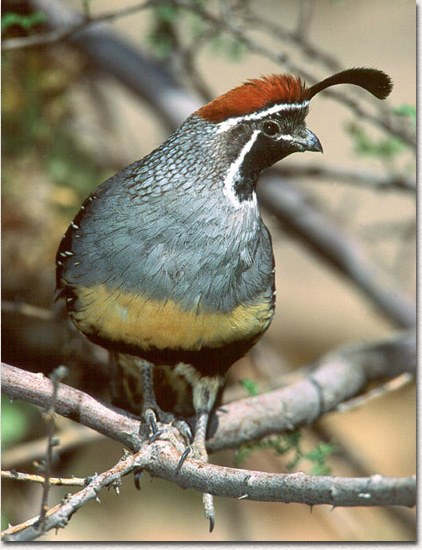
Gambel's Quail
- Habitat
- Desert scrublands, thickets along streams, chaparral, scrubby mountain ravines; arid habitat near permanent water
- Size
- 10 in
- Lifespan
- Average wild lifespan is only about 1.5 years; few individuals survive past 4 years.
- Diet
- Mostly leaves, plant shoots, insects, and fruit
About the Gambel's Quail
Gambel's Quail is a stocky, ground-dwelling bird about 10 inches long, easily recognized by the comma-shaped black plume that curves forward from its head. Males are especially striking, showing a bold black face and throat outlined in white, a chestnut crown, a mostly gray body, and rusty flanks marked with bold diagonal white stripes. Females share the same general shape and the distinctive head plume but wear a much plainer, more subdued gray-brown plumage overall, providing better camouflage while tending eggs or chicks on the ground. The plume itself is actually a cluster of several feathers overlapping so tightly they appear as a single curved ornament, a feature shared with the closely related California Quail of the Pacific coast.
True to its desert origins, this quail is closely tied to arid landscapes, favoring desert scrublands, thickets that line seasonal streams, chaparral, and scrubby mountain ravines. Critically, it rarely strays far from a reliable source of water, since permanent water within reach is essential for the species' survival in an otherwise harsh, dry environment. This dependence on water sources means Gambel's Quail populations are often concentrated around desert washes, oases, and human-modified water sources like stock tanks and irrigation ditches, and local abundance in a given year often tracks winter and spring rainfall closely, since wetter years produce more of the green forage that fuels successful breeding.
The diet consists mostly of leaves, plant shoots, insects, and fruit, gathered by walking and scratching along the ground rather than by flying, since quail generally prefer to run from danger and only take flight as a last resort. Foraging typically happens in the cooler hours of morning and late afternoon, allowing the birds to avoid the harshest desert heat of midday. During dry years, adults are able to survive on remarkably little free water, drawing much of what they need from succulent vegetation, though breeding success drops sharply when winter rains fail to produce the usual flush of green growth.
Gambel's Quail are intensely social, living in coveys that can swell to as many as 200 birds outside the breeding season, an impressive concentration of a species whose individual lifespan is surprisingly brief. Coveys stay in contact through a range of distinctive calls, including a loud, emphatic call often rendered as sounding like "chi-ca-go," which helps scattered birds regroup after a disturbance sends the covey scrambling for cover. Within a covey, quail often roost huddled together at night in a tight circle, a behavior that conserves body heat during cold desert nights and may also let more eyes watch for approaching predators.
Average survival in the wild is only around a year and a half, and relatively few individuals live past four years, a reflection of heavy predation pressure on a ground-dwelling bird in open desert habitat. Despite these short odds for any one bird, the species compensates with large clutch sizes, sometimes a dozen eggs or more, and precocial chicks that can walk and begin feeding themselves within hours of hatching, along with the safety-in-numbers benefits of covey life, which together help keep desert populations stable across the arid Southwest.
Beyond the well-known assembly call, Gambel's Quail have an extensive vocal repertoire used to coordinate covey movements, warn of predators, and maintain contact between a pair during the breeding season, with distinct calls documented for different social contexts. Predation pressure comes from a wide range of hawks, owls, snakes, and mammalian carnivores, and quail chicks in particular face heavy losses in their first weeks of life before they grow large enough to escape most threats by running. Where its range meets that of the Scaled Quail in parts of the Southwest, the two species occasionally hybridize, though Gambel's Quail generally favor slightly lower, more mesquite-dominated habitat than their scaled relative.
Frequently asked questions
How can you identify a Gambel's Quail?
Look for a curved black head plume, a bold black face on males, a chestnut crown, and rusty flanks with diagonal white stripes.
Where do Gambel's Quail live?
They live in desert scrublands, streamside thickets, and chaparral, always staying near a reliable source of water.
How long do Gambel's Quail live?
Average wild lifespan is only about 1.5 years, and few individuals survive past 4 years.
Do Gambel's Quail live in groups?
Yes, they are highly social and gather into coveys that can number up to 200 birds, often roosting huddled together at night.
Does rainfall affect Gambel's Quail breeding success?
Yes, wetter winters and springs produce more green forage, which generally leads to better breeding success than dry years.
Where to find it
This species favors wetland habitat. See real Oklahoma locations on the Habitats map.