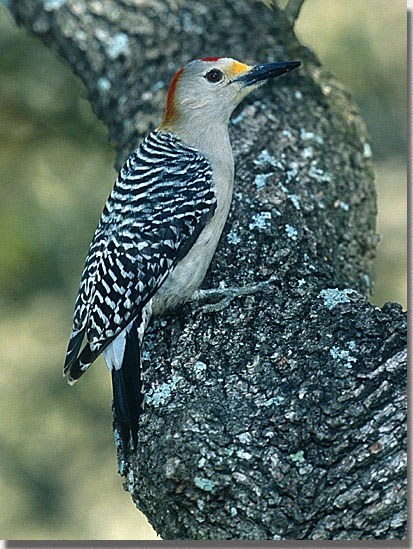
Golden-fronted Woodpecker
- Habitat
- Scrublands at deserts' edge, cottonwood groves and brushy streamside areas, wooded canyons, brushlands with cactus/mesquite, rural areas, towns, parks
- Size
- 7 in
- Lifespan
- Typically lives around 5-8 years in the wild; oldest banded bird was just under 6.
- Diet
- Fruit, including especially cactus
About the Golden-fronted Woodpecker
The Golden-fronted Woodpecker is a medium-sized woodpecker, about 7 inches long, easily recognized by its finely barred black-and-white back and a bold black-and-white pattern across the face. A patch of golden-yellow feathering sits just above the base of the bill, giving the species its name, and this same yellow tone often extends faintly onto the nape. The sexes are distinguished by the crown: males show a bright red cap, while females have a plain black crown, making it straightforward to sex a pair at a glance. It closely resembles the Red-bellied Woodpecker of the eastern United States, a close relative whose range it replaces across much of Texas and Oklahoma, and the two species occasionally come into contact and even hybridize in a narrow zone of overlap.
This woodpecker occupies a wide range of semi-arid and human-altered habitats, from scrublands at the edge of the desert and cottonwood groves to brushy streamside corridors, wooded canyons, and brushlands studded with cactus and mesquite. It has also adapted comfortably to rural areas, towns, and city parks, and within Texas it is considered the most numerous member of its family, a common and familiar sight on ranches and in urban green spaces alike. In Oklahoma, its range is centered on the southwestern part of the state, where it reaches the northern edge of its overall distribution.
Fruit makes up an important part of the diet, and cactus fruit in particular is a favored food where the species overlaps with prickly pear and other desert cacti, supplementing the insects and other invertebrates typical of most woodpeckers. Like other woodpeckers, it forages by working along trunks and branches, though its comfort around open, scrubby habitat means it also spends time foraging lower down than many forest-dwelling relatives. Individuals also cache food, wedging acorns, seeds, or other food items into bark crevices or cracks in fence posts to retrieve later, a behavior widely shared among woodpeckers in the genus Melanerpes.
As cavity-nesters, Golden-fronted Woodpeckers excavate nest holes in trees, utility poles, or large cacti, and these cavities often go on to shelter other wildlife once the woodpeckers move on, a common ecological role for excavating woodpecker species; species from small owls to flycatchers and even some reptiles regularly reuse abandoned Golden-fronted cavities. The birds also communicate and defend territory through drumming, a rapid burst of bill strikes against a resonant branch or dead limb that carries across open scrubland far better than a vocal call alone. Pairs tend to remain together on the same territory across years, defending a core area from other woodpeckers and even from unrelated cavity-nesting species competing for the same nest sites.
Their adaptability to disturbed and human-dominated landscapes, combined with a broad diet that includes both animal prey and desert fruit, has helped the species remain common and widespread across its range even as surrounding habitat has changed. Unlike many songbirds, this woodpecker does not migrate, remaining on or near the same territory throughout the year and relying on its varied diet, including cached food stores, to see it through leaner winter months.
Golden-fronted Woodpeckers also compete for nest cavities with introduced European Starlings, which can aggressively usurp a freshly excavated hole before the woodpeckers have a chance to use it themselves, a conflict shared with many native North American cavity-nesters. The species' calls include a rolling, chattering rattle used in territorial disputes, distinct from the sharper single notes given as an alarm call when a hawk or other predator is spotted nearby. Several subspecies are recognized across the bird's range from Texas and Oklahoma south through Mexico into Central America, varying somewhat in the exact tone of the golden nape patch and the extent of barring on the back, though all share the same general black-and-white pattern and red-or-black crown distinction between the sexes.
Frequently asked questions
How do you tell male and female Golden-fronted Woodpeckers apart?
Males have a red cap while females have a black cap; both sexes show the golden patch above the bill that gives the species its name.
Where does the Golden-fronted Woodpecker live?
It lives in desert-edge scrublands, cottonwood groves, wooded canyons, and cactus-mesquite brushlands, as well as towns and parks, mainly across Texas and into southwestern Oklahoma.
What does a Golden-fronted Woodpecker eat?
It eats fruit, with cactus fruit a particular favorite, in addition to typical woodpecker foods like insects, and it also caches food for later use.
Is the Golden-fronted Woodpecker common in Texas?
Yes, it is considered the most numerous member of its family in Texas, frequenting ranches and city parks.
Is the Golden-fronted Woodpecker related to the Red-bellied Woodpecker?
Yes, they are close relatives that replace each other geographically, and the two species occasionally hybridize where their ranges meet.
Where to find it
This species favors grassland habitat. See real Oklahoma locations on the Habitats map.