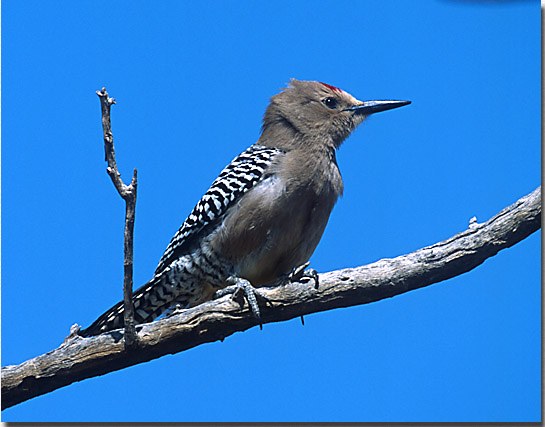
Gila Woodpecker
- Habitat
- Desert scrub and riparian woodland of the arid Southwest, especially areas with saguaro cactus
- Size
- 8-9.75 in
- Lifespan
- Long-term banding data for this species are limited, so a confident wild lifespan figure isn't well established; similarly sized related woodpeckers typically live roughly a decade in the wild.
- Diet
- Insects, cactus fruit, berries, and occasionally small lizards, eggs, or nestlings of other birds
About the Gila Woodpecker
The Gila Woodpecker is a medium-sized woodpecker with a plain tan-brown head and underparts and a back finely barred in black and white, a pattern shared with several related desert woodpeckers of the genus Melanerpes. Males have a small red patch on the crown that females lack, the only reliable difference between the sexes in the field. Worth noting honestly for Oklahoma readers: this species is a true desert specialist and does not occur in the state under normal circumstances.
Its range is centered on the Sonoran Desert region of Arizona, far southeastern California, southern Nevada, and adjacent Mexico, with a small extension into extreme southwestern New Mexico. It's closely tied to saguaro cactus country and desert riparian corridors, habitat entirely absent from Oklahoma, which lies far outside its known range; the state's closest ecological counterpart among woodpeckers of the same genus is the Golden-fronted Woodpecker, found in far southwestern Oklahoma in similarly dry brush and mesquite habitat.
The Gila Woodpecker forages actively on cactus, mesquite, and other desert vegetation for insects, drilling into wood and probing bark crevices much like other woodpeckers, and eats substantial amounts of cactus fruit and other desert plant material, particularly saguaro fruit, which ripens in the intense heat of the desert summer. It also occasionally raids the nests of smaller birds for eggs or nestlings, and will visit hummingbird feeders for sugar water, an omnivorous streak somewhat unusual for a woodpecker.
It excavates its nest cavity directly into the trunk of a living saguaro cactus, a substrate unlike the trees used by most woodpeckers. Because the saguaro's tissue responds to the wound by forming a hardened, scar-like callus around the excavation, sometimes called a 'saguaro boot,' the cavity becomes a durable structure that continues to provide shelter for a wide range of other desert wildlife, including Elf Owls, Ash-throated Flycatchers, and other cavity-nesting species, for years after the woodpecker itself has moved on to excavate a new hole elsewhere. This close, almost architectural relationship between one bird species and one plant species is considered a classic example of desert ecological interdependence, illustrating how a single cactus can indirectly support an entire community of secondary cavity-nesting animals long after the original excavation was made.
Frequently asked questions
Is the Gila Woodpecker actually found in Oklahoma?
No; this is a true desert Southwest species centered on Arizona and the Sonoran Desert, and it does not occur in Oklahoma under normal circumstances.
Why does it nest in saguaro cactus?
Saguaros provide a sturdy, moisture-regulated cavity once the plant forms a hardened callus around the excavation, offering good insulation in the desert climate.
What is a 'saguaro boot'?
The hardened, scar-like structure a saguaro cactus forms around a woodpecker's nest cavity, which can persist and shelter other wildlife long after the original nest is abandoned.
What does it eat besides insects?
A substantial amount of its diet includes cactus fruit and other desert plant material, along with occasional eggs or nestlings of other birds.
Where to find it
This species favors grassland habitat. See real Oklahoma locations on the Habitats map.