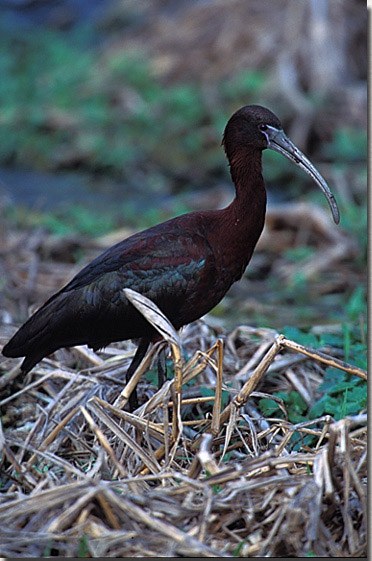
Glossy Ibis
- Habitat
- Freshwater and brackish marshes, flooded fields, wet meadows, and shallow impoundments
- Size
- About 19-26 inches long, with a long down-curved bill and roughly a 3-foot wingspan
- Lifespan
- Most wild birds likely live well under 10 years, but banding data show much greater potential: the oldest confirmed banded individual reached at least 21 years, and one captive bird lived nearly 27 years
- Diet
- Aquatic and soil invertebrates such as crayfish, insects, earthworms, and small fish and frogs
About the Glossy Ibis
At a distance the Glossy Ibis looks almost uniformly blackish, but in good light its plumage reveals a rich mix of chestnut, bronze-green, and purple iridescence, especially during the breeding season when the bare facial skin turns a pale blue-gray bordered by thin blue lines. Its most distinctive feature is the long, evenly down-curved bill, used like a pair of tweezers to feel for prey in soft mud and shallow water. In flight, ibises travel in loose lines or V-formations with necks and legs fully extended, distinguishing them from herons, which fold their necks back.
Glossy Ibis is actually native to the Old World, and its establishment in the Americas is a relatively recent and still-expanding event; the species likely reached Florida and the Gulf Coast on its own within the last two centuries and has since spread up the Atlantic seaboard and inland. In Oklahoma it remains an uncommon to rare visitor, most likely seen at wetlands and shallow lake margins during spring or fall migration rather than as a breeding resident.
Foraging birds wade steadily through shallow water or wet fields, sweeping the bill from side to side or probing directly into mud and vegetation to locate prey by touch as much as sight. This tactile foraging style lets them feed effectively in murky water or overnight, and flocks often forage and roost alongside herons, egrets, and other ibises.
Glossy Ibis nests colonially, often in mixed wetland-bird rookeries built in trees, shrubs, or reeds over water, alongside herons and egrets. Pairs build a platform nest of sticks and typically lay three to four pale blue-green eggs. This colonial, mixed-species nesting strategy offers extra protection from predators and reflects the ibis's generally social, flocking habits outside the breeding season as well, when birds gather in large numbers to feed and roost together.
Rather than following a fixed north-south migration route, Glossy Ibis populations show a strong tendency toward post-breeding dispersal, with individuals wandering in various directions, sometimes hundreds of miles, once nesting duties are finished. This dispersal behavior is likely the reason the species has been able to colonize new regions so readily and why wandering individuals occasionally turn up well outside their usual coastal range, including at inland wetlands in states like Oklahoma. Because it forages so often in mixed-species groups alongside egrets and herons, careful observers can also use the ibis's distinctive silhouette and flight style, steady wingbeats interspersed with short glides, to help separate it from those other wading birds even at a distance.
Frequently asked questions
Is the Glossy Ibis native to North America?
It is originally an Old World species that colonized the Americas naturally, likely within the past couple of centuries, and its range here is still expanding.
Why does the Glossy Ibis have such a long, curved bill?
The bill is a specialized tactile tool used to probe mud and shallow water for hidden invertebrates like crayfish and worms.
Is the Glossy Ibis common in Oklahoma?
No, it is considered rare to uncommon in Oklahoma, occurring mainly as a wetland visitor during migration.
Does the Glossy Ibis nest alone or in groups?
It nests colonially, often mixed in with herons and egrets in wetland tree or shrub rookeries.
Where to find it
This species favors wetland habitat. See real Oklahoma locations on the Habitats map.