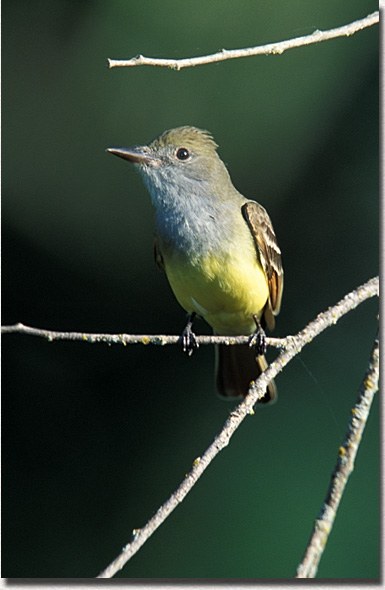
Great-crested Flycatcher
- Habitat
- Deciduous and mixed woodlands, forest edges, orchards, and wooded suburban areas with nesting cavities
- Size
- About 6.7-8.3 inches long
- Lifespan
- The oldest banded individual on record was at least 14 years, 11 months old
- Diet
- Mostly flying insects captured in the air, along with some berries and small fruit
About the Great-crested Flycatcher
The Great-crested Flycatcher is a large, boldly patterned flycatcher with an olive-brown back, a gray throat and breast, a lemon-yellow belly, and rufous tones in the wings and tail visible in flight. Its slight, bushy crest gives the head a peaked look, and its loud, rising "wheeep" call is often the first clue to its presence, since the bird tends to stay high in the leafy canopy.
This species breeds across the eastern and central United States, including Oklahoma, favoring open deciduous and mixed woodlands, forest edges, and even orchards or leafy suburban neighborhoods, as long as dead trees or nest boxes provide cavities. Unlike most other flycatchers, it is a secondary cavity-nester, using old woodpecker holes, natural tree hollows, or nest boxes rather than building an open cup nest.
True to its family, it hunts primarily by sallying out from a perch to snatch flying insects such as beetles, moths, and wasps in midair, then returning to the same or a nearby perch. It also takes some caterpillars and other insects gleaned from foliage, and shifts toward fruit and berries when insect availability drops, particularly before migration. Great-crested Flycatchers winter mainly in Mexico, Central America, and northern South America, making them a long-distance migrant that spends only the warmer months in Oklahoma before departing in late summer or early fall.
A well-known quirk of this species is its habit of lining the nest cavity with a shed snakeskin, or in more developed areas, a shiny substitute like cellophane or plastic wrapping. The exact function is debated, but the leading idea is that the crinkly, reflective material helps deter squirrels and other cavity-raiding predators from investigating the nest. Pairs are territorial around their nest cavity and can be quite aggressive toward intruders, including much larger birds, when defending eggs or young.
Great-crested Flycatchers typically return to Oklahoma in mid-spring, somewhat later than many other migratory songbirds, timed to coincide with the emergence of the flying insects that make up the bulk of their diet. Because it relies on cavities rather than building an open nest, the species can benefit noticeably from artificial nest boxes in areas where dead trees and old woodpecker holes are scarce, and it will readily accept boxes placed at the right height along woodland edges. Its loud, distinctive calls, often given from high in the canopy, make it one of the more easily detected woodland birds by sound even when it stays hidden among the leaves.
Frequently asked questions
Why does the Great-crested Flycatcher use snakeskin in its nest?
It often lines its cavity nest with a shed snakeskin or a shiny plastic substitute, likely to help discourage predators from entering.
Does the Great-crested Flycatcher build its own nest hole?
No, it is a secondary cavity-nester that relies on old woodpecker holes, natural hollows, or nest boxes.
How does this flycatcher typically catch its food?
It sallies out from a perch to snatch flying insects in midair, then returns to a perch to eat.
Where would you look for a Great-crested Flycatcher in Oklahoma?
In deciduous or mixed woodland with mature trees, forest edges, or wooded suburban areas offering cavities for nesting.
Where to find it
This species favors forest habitat. See real Oklahoma locations on the Habitats map.