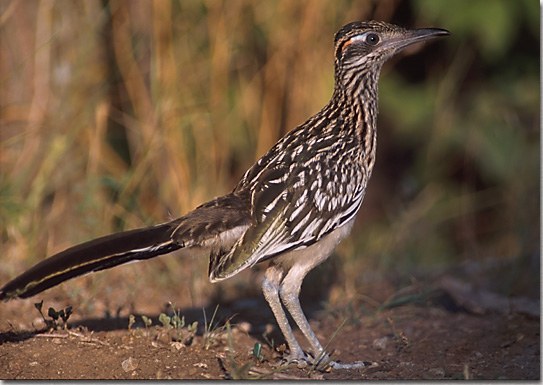
Greater Roadrunner Oklahoma Facts and Identification: habitat, diet, speed, and behavior guide for this ground bird
- Habitat
- Desert scrubland, arid open country, mesquite groves, chaparral, grasslands, agricultural areas
- Size
- 24 in; larger than a crow, long legs and tail
- Lifespan
- Typically lives about 7-8 years in the wild, matching its oldest known banding record.
- Diet
- Mostly animals — insects, lizards, snakes, rodents, birds; also fruit and seeds
About the Greater Roadrunner: Oklahoma facts
This Greater Roadrunner Oklahoma facts page covers habitat, diet, speed, and behavior for one of the most recognizable ground birds in the state. Oklahoma facts about this species often surprise people — it rarely flies, preferring to sprint after prey on foot. Anyone searching for Greater Roadrunner Oklahoma sightings will find this bird across the state’s arid scrubland and open country.
The Greater Roadrunner is a large, unmistakable ground bird about 24 inches long, bigger than a crow, with long legs, a long tail, and a shaggy head crest that gives it an alert, slightly comical profile. Rather than flying, this bird does almost everything on foot, using its long legs and tail for balance as it sprints across open ground with its neck stretched forward, reaching speeds around 15 miles per hour when chasing prey or fleeing danger. Despite its fame in popular culture as a bold, brash cartoon character, the real bird is mostly shy and ground-dwelling, more often glimpsed dashing across a trail than posing in the open. A patch of bare, brightly colored skin behind the eye, ranging from blue to orange depending on the bird's mood and the light, is another distinctive feature visible at close range.
Roadrunners are creatures of the arid Southwest, favoring desert scrubland, arid open country, mesquite groves, chaparral, grasslands, and agricultural areas where sparse vegetation leaves plenty of open ground for running down prey. Their diet reflects a genuinely predatory lifestyle unusual among common backyard-adjacent birds: insects, lizards, snakes, rodents, and even other birds make up the bulk of what they eat, supplemented with fruit and seeds when animal prey is scarce. Roadrunners are notably capable snake hunters, using speed and a quick strike to subdue and swallow prey that many other birds would avoid entirely, including rattlesnakes considerably longer than the bird itself, which are typically battered against a rock and swallowed gradually as digestion allows more of the snake to fit.
A signature behavior is the side-to-side tail shake the bird performs while standing, a visual display whose exact function is still debated among ornithologists. In cold weather, roadrunners have the unusual ability to lower their own body temperature at night to conserve energy, then bask with feathers fluffed and back exposed to the morning sun to rewarm quickly, a useful adaptation for a ground-dwelling bird in a desert climate with cold nights. Patches of dark skin on the roadrunner's back help absorb heat efficiently during these morning basking sessions, letting the bird recover overnight energy losses before beginning its day of hunting.
Pairs are generally monogamous and defend a shared territory year-round, reinforcing the bond with a mutual bowing display and gifts of food passed from male to female during courtship, a behavior that likely helps signal a male's hunting ability before egg-laying begins. Nests are built low in a thorny shrub, cactus, or small tree, offering some protection from ground predators while still keeping the flightless-feeling adults close to the ground they prefer.
Young roadrunners develop remarkably fast: chicks are capable of catching their own prey at just three weeks of age, a rapid path to independence that suits a species living in a habitat where food can be unpredictable and parental resources limited. In the wild, roadrunners typically live around 7 to 8 years, matching the oldest documented banding record for the species.
Vocally, the Greater Roadrunner gives a descending, dove-like series of cooing notes during the breeding season, a surprisingly soft sound for a bird otherwise associated with rattling bill-clacks and sharp alarm notes. Despite its speed and predatory reputation, the roadrunner itself is vulnerable to larger hawks, owls, and mammalian predators, especially as an egg or nestling, and adults rely heavily on cryptic coloring and a quick dash into thorny cover to avoid becoming prey themselves. The bird's long association with Southwestern folklore, including beliefs among some Indigenous communities that its X-shaped footprint, with two toes forward and two back, could confuse evil spirits about the direction the bird had traveled, reflects just how deeply this striking, ground-dwelling cuckoo has embedded itself in the cultural imagination of the desert Southwest.
Frequently asked questions
Can Greater Roadrunners actually run fast?
Yes, they can run at roughly 15 miles per hour with their neck outstretched, though they are ground-dwelling and generally shy rather than bold.
What do Greater Roadrunners eat?
They eat mostly animals such as insects, lizards, snakes, rodents, and birds, along with some fruit and seeds, and are capable of subduing snakes longer than themselves.
How does a roadrunner handle cold desert nights?
It lowers its body temperature to conserve energy overnight, then basks in the morning sun to warm back up.
How quickly do young roadrunners become independent?
Chicks can catch their own prey at just three weeks old.
Do Greater Roadrunners mate for life?
Pairs are generally monogamous and defend a shared territory year-round, reinforcing the bond with mutual bowing displays and courtship food gifts.
Where to find it
This species favors grassland habitat. See real Oklahoma locations on the Habitats map.