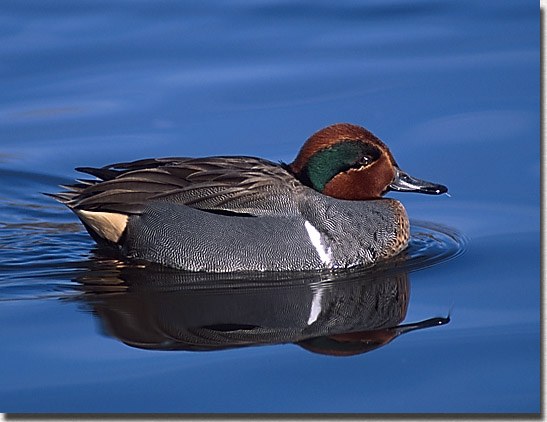
Green-winged Teal
- Habitat
- Shallow marshes, wetlands, flooded fields, and small ponds
- Size
- About 14 inches long, the smallest dabbling duck in North America
- Lifespan
- The oldest banded individual on record reached at least 20 years, 3 months
- Diet
- Seeds of aquatic plants and grasses, along with aquatic invertebrates such as insects and mollusks
About the Green-winged Teal
The Green-winged Teal is a compact, fast-flying dabbling duck. Breeding males show a rich chestnut head with an iridescent green eye patch, a spotted buffy breast, and a gray body set off by a vertical white stripe near the shoulder, while females are mottled brown overall, distinguished mainly by their small size and the iridescent green speculum in the wing that gives the species its name.
This is a widespread species, breeding across the northern United States and much of Canada and Alaska, then wintering broadly across the southern and central United States, including Oklahoma, where it is a common sight on shallow wetlands, flooded agricultural fields, and small ponds during the colder months. Its small size lets it use very shallow water and mudflats that larger ducks cannot exploit as easily.
Green-winged Teal feed mainly by dabbling at the surface, tipping up, or walking through mud and shallow water to pick up seeds of grasses, sedges, and aquatic plants, along with small invertebrates like aquatic insects and mollusks, especially important protein during the breeding season. Their small body size and light weight let flocks feed on very shallow sheet water and exposed mudflats where larger dabbling ducks would struggle, and they are known for tight, agile flock flight, twisting and turning together almost like shorebirds.
Pairs form on the wintering grounds or during migration, and females nest on the ground in dense vegetation near water in northern breeding areas, incubating a clutch typically in the high single digits. As with most ducks, only the female incubates and tends the ducklings, which are precocial and able to feed themselves within hours of hatching. The species remains one of the more numerous and stable duck populations in North America, valued by waterfowl hunters and birders alike for its abundance and striking male plumage.
Green-winged Teal are often among the earliest ducks to arrive on Oklahoma wetlands in fall and among the latest to depart in spring, since their small size and dabbling habits let them exploit very shallow water and mud that freezes over less readily than deeper ponds. Large numbers can gather at flooded fields and shallow marsh edges during migration, often mixed with other dabbling ducks such as pintails and wigeon, and their quick, twisting flock flight is a recognizable sight over wetland habitat throughout the colder months.
Frequently asked questions
Why is the Green-winged Teal called that?
Its name refers to the bright green patch in the wing, called the speculum, visible in both sexes.
Is the Green-winged Teal the smallest duck in North America?
It is the smallest dabbling duck on the continent, though a few diving ducks are comparably small.
When would you see Green-winged Teal in Oklahoma?
Mainly during fall through spring, since the species winters in the state and breeds much farther north.
How do Green-winged Teal typically feed?
They dabble at the surface or tip up in shallow water and mudflats, eating seeds and small aquatic invertebrates.
Where to find it
This species favors wetland habitat. See real Oklahoma locations on the Habitats map.