Green Heron
- Habitat
- Common near streams, ponds, marshes, coastal wetlands, lake shores, wet woodlands, mangroves; both fresh and salt water
- Size
- 16–22 in (no wingspan given)
- Lifespan
- Oldest banded individual on record lived about 9 years; typical wild lifespan is shorter.
- Diet
- Fish, insects, aquatic and terrestrial invertebrates, lower vertebrates; mostly fish in late summer
About the Green Heron
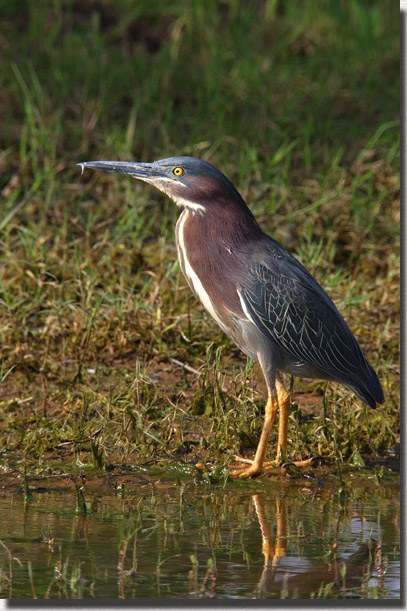
The Green Heron is a small, dark, crow-sized heron, about 16 to 22 inches long, that often appears almost entirely dark at a distance despite a genuinely handsome combination of colors up close. Adults show a glossy, greenish-black crown, a rich chestnut neck, bright orange legs, and a small patch of white running down the center of the throat and neck. The overall effect is a compact, hunched-looking bird that can look surprisingly small and stocky compared to its larger heron relatives, and it is easily overlooked perched motionless at the water's edge until it suddenly flushes with a sharp, startled call.
This species favors a wide range of watery edges, including streams, ponds, marshes, coastal wetlands, lake shores, wet woodlands, and mangroves, and it is equally at home along both fresh and salt water. Rather than the open, wading approach used by larger herons, Green Herons often hunt from a low, hunched perch at the water's edge, striking downward at passing prey with a quick jab of the bill. Even small backyard ponds and drainage ditches can attract a hunting Green Heron, making it one of the more adaptable herons when it comes to using modified or artificial water features.
The diet includes fish, insects, and both aquatic and terrestrial invertebrates along with smaller vertebrates, and the balance shifts noticeably through the year, with fish making up the majority of what is eaten by late summer as other prey becomes less available. Green Herons are among the relatively small number of bird species known to use tools, sometimes dropping bait such as bread crusts, feathers, or small insects onto the water's surface to lure fish within striking distance, a behavior that highlights unusual problem-solving ability for a wading bird and has been documented repeatedly at both wild and urban pond sites.
Solitary and quick in flight, Green Herons are also expressive when alarmed: a startled bird will flick its tail sharply downward, stretch its neck up, and raise the shaggy crest on its crown, a combination of visual signals that likely serves to warn off intruders or signal alarm to nearby birds. The species keeps mostly to itself outside the breeding season, rarely gathering in the large communal groups typical of larger heron and egret species, though a loose cluster of nests may form in suitable streamside thickets. Nests are built in trees or dense shrubs near water, often not far above the surface, and both parents share incubation and feeding duties for a brood that typically fledges within a few weeks of hatching.
The oldest banded Green Heron on record lived about 9 years, though the typical wild lifespan is considerably shorter given the everyday hazards facing a small, solitary wading bird. In Oklahoma, the species arrives in spring and departs by early fall for wintering grounds farther south, making it a reliably seasonal presence along the state's ponds, creeks, and wooded wetland edges each summer.
Juvenile Green Herons look notably different from the sleek adults, showing a streaked, browner breast and duller upperparts that provide some camouflage during the vulnerable weeks after fledging, before molting into the glossier adult plumage over their first year. Predators of eggs and young include snakes, raccoons, and larger wading birds, and nest placement near or over water offers some protection against ground-based threats, though it does little to deter aerial predators like crows and grackles. Across its extensive range, from Canada through much of Central America and the Caribbean, the species shows some regional variation in size and the intensity of its chestnut neck color, though all populations share the same basic hunting behavior and tool-using ingenuity that make the Green Heron one of the more intelligent-seeming herons to watch.
Frequently asked questions
What color is a Green Heron?
It has a dark, greenish-black crown, a chestnut neck, orange legs, and a white patch down the center of the throat and neck.
Where do Green Herons live?
They live near streams, ponds, marshes, lake shores, wet woodlands, and mangroves, in both fresh and salt water, including small artificial ponds.
What does a Green Heron do when alarmed?
It flicks its tail downward, stretches its neck, and raises its crest when alarmed.
What does a Green Heron eat?
It eats fish, insects, and aquatic and terrestrial invertebrates, with fish making up most of the diet by late summer.
Is it true Green Herons use tools to catch fish?
Yes, they are one of the few bird species documented dropping bait like bread or insects onto the water to lure fish within striking range.
Where to find it
This species favors wetland habitat. See real Oklahoma locations on the Habitats map.