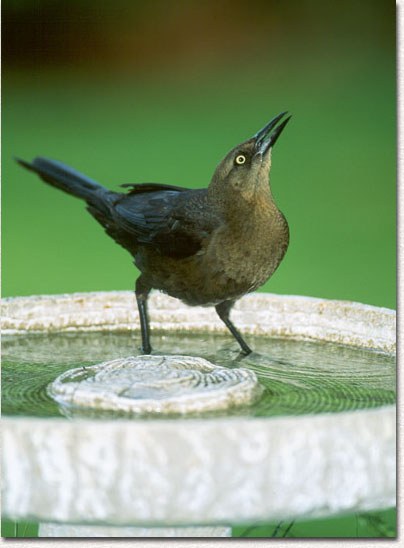
Great-tailed Grackle
- Habitat
- Parks, towns, fast-food parking lots, ranches, coastal marshes, wetlands, flatlands with trees; usually near water
- Size
- Male 16–17 in, female 12–14 in, tail very long and keel-shaped
- Lifespan
- Reliable banding records show individuals living to about 8 years, possibly longer in some cases.
- Diet
- Insects, lizards, aquatic invertebrates and vertebrates, ectoparasites from domestic stock, bird eggs, nestlings, fruit, grain, grass seeds
About the Great-tailed Grackle
The Great-tailed Grackle shows one of the most pronounced size differences between the sexes of any North American songbird: males stretch 16 to 17 inches long, while females are noticeably smaller at 12 to 14 inches. Both sexes carry a very long, distinctively keel-shaped tail that they can fold into a deep V-shape in flight, a feature that makes the species easy to identify at a distance even before other plumage details come into view. Males are glossy black with an iridescent sheen, while females tend toward a duller brown, a common pattern of sexual dimorphism among blackbirds.
The species has adapted remarkably well to human landscapes, and today it turns up in parks, towns, and fast-food parking lots as readily as in its more traditional haunts of ranches, coastal marshes, wetlands, and open flatlands with scattered trees. Across nearly all of these settings, Great-tailed Grackles tend to stay close to water, whether a natural wetland or nothing more than a parking-lot retention pond.
Its diet is broad and opportunistic, including insects, lizards, aquatic invertebrates and vertebrates, ectoparasites picked directly off the backs of livestock, bird eggs and nestlings, fruit, grain, and grass seeds. This flexible, almost omnivorous approach to feeding is a major reason the species has thrived alongside expanding human development across the southern and central United States.
Great-tailed Grackles nest colonially, with nests often placed close together in a single stand of trees or reeds, sometimes housing anywhere from a handful of pairs to several thousand. That crowding produces plenty of social friction: females frequently squabble over prime nest sites and are known to steal nesting material directly from their neighbors' nests rather than gather all of it themselves. Males mate with multiple females within a colony and take no part in incubation or feeding chicks, leaving nest duties entirely to the females while they focus on defending display perches and competing with rival males. The species is also known for its vocal repertoire, often described as a genuinely odd and unusual song, a mix of harsh, metallic, and whistled notes that can sound almost mechanical. Banding records show individuals reliably living to around 8 years old, with some evidence that a small number may live even longer.
Frequently asked questions
Why do male and female Great-tailed Grackles look so different in size?
Males are much larger, 16 to 17 inches, compared to females at 12 to 14 inches, one of the biggest sexual size differences among North American songbirds.
Where do Great-tailed Grackles live?
They live in parks, towns, parking lots, ranches, coastal marshes, and wetlands, usually staying close to water.
What does the Great-tailed Grackle's song sound like?
It has been described as a very weird, unusual song made up of harsh and whistled notes.
Do Great-tailed Grackles nest in groups?
Yes, they nest colonially with nests placed close together, and females often squabble over nest sites and steal materials from each other.
Where to find it
This species favors wetland habitat. See real Oklahoma locations on the Habitats map.