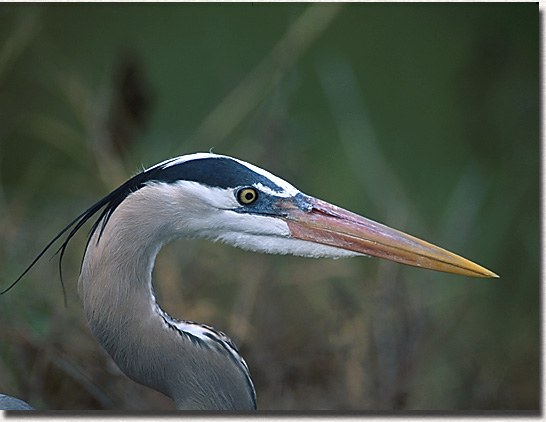
Great Blue Heron
- Habitat
- Common in river/lake edges, wet meadows, freshwater marshes, swamps, fields, and other wetland environments
- Size
- 39–52 in
- Lifespan
- Averages roughly 15 years in the wild after surviving a risky first year; oldest banded bird topped 24.
- Diet
- Mostly fish, but opportunistic — including human food scraps, nestlings, small mammals
About the Great Blue Heron
The Great Blue Heron is North America's largest and most familiar heron, standing an impressive 39 to 52 inches tall on long legs built for wading in shallow water. Its slate-blue-gray plumage, long S-curved neck, and dagger-like yellow bill make it instantly recognizable, whether standing motionless at a pond's edge or flying overhead with slow, deliberate wingbeats, legs trailing straight behind and its head folded back into an S-shape rather than extended forward like a crane's. A shaggy plume of feathers trails from the back of the head in breeding adults, and a rare all-white form found mainly in Florida and the Caribbean is sometimes treated as a distinct color morph rather than a separate species.
This heron is a true wetland generalist, turning up along the edges of rivers and lakes, in wet meadows, freshwater marshes, swamps, and even flooded agricultural fields, essentially any environment offering shallow water and a supply of prey. That adaptability extends to diet as well: although fish make up the bulk of what a Great Blue Heron eats, it is an opportunistic feeder that will readily take small mammals, nestlings of other birds, and even scavenged human food scraps when the chance arises. This flexibility allows the species to persist even in developed and agricultural landscapes where more specialized wetland birds struggle to find suitable habitat, and individuals are increasingly reported hunting far from water, stalking rodents in open fields or vacant lots.
Hunting strategy is where the species truly shines. A Great Blue Heron will often stand rigidly still in shallow water for long stretches, waiting for a fish or other prey to venture within striking range before lunging forward with startling speed and precision. Activity is not evenly spread through the day; the species is described as most active in the low light just before dawn and again at dusk, hours when many fish move into shallower water and are easier to ambush. Large prey items are sometimes swallowed only after a struggle, and herons have occasionally been documented choking on fish too large to manage, an uncommon but real hazard of the species' opportunistic hunting style.
Life is precarious for young Great Blue Herons, and the first year after fledging carries substantial risk from predation, starvation, and other hazards. Birds that make it past that difficult first year, however, can go on to live a comparatively long life for a wading bird, averaging roughly 15 years in the wild, with the oldest banded individual on record surviving past 24 years. Great Blue Herons typically nest colonially in tall trees, sometimes alongside egrets and other herons, forming noisy rookeries that can hold dozens of nests high above the water they depend on for food, and the same rookery site is often reused and expanded year after year as long as the trees remain standing and undisturbed.
A very large, pale subspecies known as the Great White Heron occurs only in the Florida Keys and nearby areas, and its taxonomic status has been debated, with some researchers treating it as a color morph of the Great Blue Heron and others favoring recognition as a distinct form. Vocally, the species gives a harsh, guttural squawk when startled or when defending its nest, a sound that can carry surprisingly far across a quiet wetland. In the crowded conditions of a large rookery, chicks face real risk from sibling aggression over food as well as from opportunistic predators such as raccoons, crows, and eagles that raid nests low enough to reach, making early nestling survival one of the more precarious stages of the species' life cycle even before the challenges of the vulnerable first year after fledging.
Frequently asked questions
How big is a Great Blue Heron?
It stands between 39 and 52 inches tall, making it the largest heron commonly seen in North America.
How does a Great Blue Heron hunt?
It stands motionless in shallow water waiting for prey to come within range, then strikes suddenly with its bill.
What time of day are Great Blue Herons most active?
They are most active just before dawn and at dusk.
How long do Great Blue Herons live?
They average roughly 15 years in the wild after surviving a risky first year, with the oldest banded bird reaching over 24 years.
Do Great Blue Herons only hunt near water?
Mostly, but they are opportunistic enough to sometimes hunt rodents in open fields or vacant lots well away from any water source.
Where to find it
This species favors wetland habitat. See real Oklahoma locations on the Habitats map.