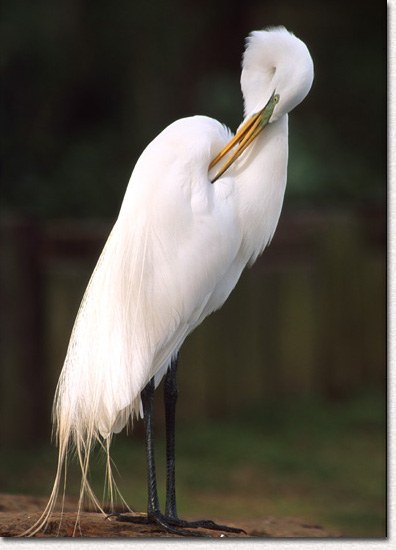
Great Egret
- Habitat
- Common worldwide in freshwater/saltwater marshes, ponds, lagoons, streams, lakes, mangrove swamps, mud flats; prefers open habitats for feeding
- Size
- 35–41 in (wingspan not stated)
- Lifespan
- Typical wild lifespans are modest, but the oldest banded individual reached almost 23 years.
- Diet
- Insects, lower vertebrates, small birds; young are usually fed frogs, crayfish, fish
About the Great Egret
The Great Egret is a large, all-white wading bird measuring 35 to 41 inches, with a long, slender neck, a straight yellow bill, and long black legs that let it wade confidently through the shallow water it depends on for hunting. Its pure white plumage made it a prime target for plume hunters in the late 19th and early 20th centuries, when ornate feathers were prized for women's hats; the species' dramatic population collapse and subsequent recovery became one of the founding stories behind modern bird conservation in North America, and the Great Egret's silhouette remains the official emblem of the National Audubon Society to this day.
Today the Great Egret is found on nearly every continent except Antarctica, and in North America it frequents an unusually broad range of wetland habitats, including freshwater and saltwater marshes, ponds, lagoons, streams, lakes, mangrove swamps, and mud flats. It shows a clear preference for open habitats while feeding, likely because unobstructed sightlines make it easier to spot prey moving through the water. During the breeding season, adults grow long, delicate plumes called aigrettes from the back that extend well past the tail, the very feathers that once made the species so valuable to the plume trade, along with a patch of bare skin near the eye that briefly turns a vivid green during peak courtship.
Hunting Great Egrets are patient, solitary stalkers, moving with slow, deliberate steps through shallow water before striking prey with a quick thrust of the bill. The diet includes insects, small vertebrates, and small birds, while chicks back at the nest are typically provisioned with frogs, crayfish, and fish brought in by the parents. Sibling rivalry in the nest can be intense, and the oldest, largest chick will sometimes attack and even kill a younger, weaker nestmate during lean years, a harsh but well-documented survival strategy that concentrates limited food on the offspring most likely to fledge successfully. In flight, the species is often described as buoyant and graceful, with slow wingbeats that carry its long body and neck, folded back in classic heron fashion, smoothly through the air.
Outside the breeding season, Great Egrets frequently roost together communally in trees at night, gathering in numbers even though they hunt alone during the day. Great Egrets typically nest colonially as well, often alongside herons and other egret species in mixed rookeries, where the size and vigor of a colony can offer some collective defense against predators targeting eggs and chicks. Lifespan in the wild tends to be relatively modest for most individuals, but the record for a banded bird stands at almost 23 years, showing that under the right conditions this elegant wader can live a remarkably long life. The species' recovery from near-decimation by plume hunters, aided by early bird protection laws, remains one of the clearest success stories in American wildlife conservation.
The Great Egret's call is a low, harsh croak or guttural squawk, given mainly around the nest during disputes with neighbors or when a predator approaches, since the species is otherwise largely silent while foraging alone. Several subspecies are recognized across the bird's near-global range, varying somewhat in size and in the exact shade of the bare facial skin during breeding, with the American form generally considered among the larger populations. Nest predators include raccoons, crows, and various snakes, and colonies sited on predator-free islands or over standing water tend to fledge far more young than those more accessible to ground-based threats, a pattern that has shaped where the species chooses to establish its rookeries across its very wide distribution.
Frequently asked questions
Why was the Great Egret historically hunted?
It was hunted for its ornate plumes, which were used to decorate women's hats in the late 19th and early 20th centuries.
How does a Great Egret hunt?
It hunts alone, stalking prey slowly and methodically through shallow water before striking with its bill.
Where do Great Egrets live?
They live in freshwater and saltwater marshes, ponds, lagoons, lakes, mangrove swamps, and mud flats worldwide.
How long can a Great Egret live?
Typical wild lifespans are modest, but the oldest banded individual on record reached almost 23 years.
Do Great Egret chicks get along in the nest?
Not always, sibling rivalry can be intense, and the oldest chick will sometimes kill a younger nestmate when food is scarce.
Where to find it
This species favors wetland habitat. See real Oklahoma locations on the Habitats map.