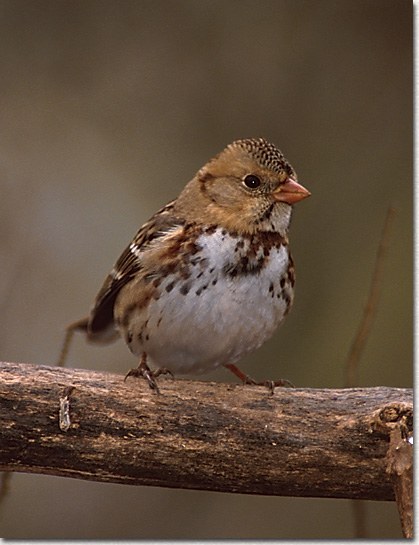
Harris' Sparrow
- Habitat
- Boreal forest clearings, brushy areas near streams, woodland edges, hedgerows, brushlands
- Size
- 7½ in, the largest sparrow
- Lifespan
- Oldest banded bird was nearly 12 years old, well beyond its more typical few-year lifespan.
- Diet
- Seeds, berries, insects including spiders, a few snails; forb, grass, sedge, rush seeds
About the Harris' Sparrow
Harris's Sparrow is the largest sparrow found in North America, measuring about 7½ inches long, with a bulky build that sets it apart from smaller, more delicate sparrow species. Adults are striking birds, showing a solid black crown, throat, and chest set against a warm brown back, wings, and tail, a bold pattern that makes breeding adults easy to identify. Immature birds look quite different, with buffy faces and only partial dark markings rather than the solid black crown and throat of the adult, which can make young birds trickier to identify in mixed winter flocks. The pink, conical bill is another useful mark shared by birds of all ages, standing out clearly against the black-and-brown head pattern of adults.
The species has an unusually restricted and well-defined range for a North American songbird: it is likely the only species that spends the entire summer breeding season exclusively in Canada and the entire winter exclusively within the United States, without breeding or wintering ranges overlapping the border in the way many other migratory species do. During the breeding season the birds favor boreal forest clearings, while in winter they turn up in brushy areas near streams, woodland edges, hedgerows, and other brushland habitat further south, with Oklahoma and neighboring states forming a core part of the species' wintering range.
Harris's Sparrows forage largely on the ground and in low vegetation for seeds, berries, and insects, including spiders and occasional snails, along with the seeds of various forbs, grasses, sedges, and rushes. This varied diet allows the species to get through the winter months on a mix of plant and animal food even as insect availability drops with the cold, and birds readily visit backyard feeding stations offering sunflower seed and mixed seed scattered on or near the ground.
In winter flocks that often include several other sparrow species, Harris's Sparrows tend to dominate, using their larger size and bold black facial markings to assert themselves over smaller companions at feeding areas. This dominance is reinforced through visual displays, with the extent of black on the crown and throat serving as a signal of social status within the flock, so that older, more heavily marked adults generally outrank younger, more mottled birds in disputes over food and perch space. Flocks maintain a loose social hierarchy through the winter, and the same individuals often return to the same wintering territory year after year, a pattern known as winter site fidelity that has been documented through repeated banding recaptures.
Longevity data suggests most individuals live only a few years in the wild, though the oldest banded bird on record reached nearly 12 years, a striking outlier for a small songbird facing the usual hazards of migration and winter survival. Because the breeding grounds lie in remote stretches of the Canadian boreal forest rarely visited by ornithologists, Harris's Sparrow remains one of the more incompletely studied common North American songbirds, and much of what is known about its nesting biology comes from a relatively small number of dedicated studies.
Harris's Sparrow undergoes a distinctive molt pattern in which the black crown and throat feathers of the breeding adult are gradually acquired through successive molts rather than appearing all at once, so that some individuals show intermediate amounts of black even as full adults, adding to the complexity of aging birds precisely in the field. Predators on the wintering grounds include Cooper's Hawks and other bird-eating raptors that regularly patrol brushy edges where sparrow flocks gather, and the dense cover Harris's Sparrows favor likely offers meaningful protection against these aerial threats. The species was also one of the last North American songbirds to have its breeding grounds definitively located and described by ornithologists, a fact that speaks to the remoteness of its Canadian boreal breeding range.
Frequently asked questions
Is Harris's Sparrow really the largest sparrow?
Yes, at about 7½ inches, it is considered the largest sparrow species in North America.
Where does Harris's Sparrow breed and winter?
It is likely the only species that breeds entirely in Canada and winters entirely in the United States, with Oklahoma part of its core wintering range.
How can you tell an adult from an immature Harris's Sparrow?
Adults have a solid black crown and throat, while immatures have buffy faces without the solid black markings.
Does Harris's Sparrow dominate other sparrows in winter?
Yes, it tends to dominate mixed winter sparrow flocks, likely due to its larger size and bold black markings.
Do the same Harris's Sparrows return to the same wintering spot each year?
Often yes, banding studies show many individuals display strong site fidelity, returning to the same wintering territory across multiple years.
Where to find it
This species favors forest habitat. See real Oklahoma locations on the Habitats map.