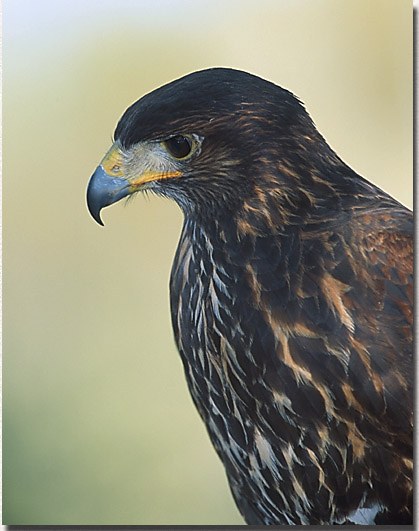
Harris' Hawk
- Habitat
- Desert scrub, mesquite grassland, and open arid country of the southwestern United States
- Size
- About 18-23 inches long with a wingspan around 40-47 inches
- Lifespan
- The oldest wild banded individual on record was at least 15 years old; captive birds have lived well beyond 20 years
- Diet
- Rabbits, rodents, lizards, and birds, hunted alone or cooperatively in family groups
About the Harris' Hawk
Harris' Hawk is a strikingly marked raptor with a chocolate-brown body, chestnut shoulders and thighs, long yellow legs, and a black tail crossed by a bold white band at the base and tip. It is a mid-sized, long-legged hawk built for maneuvering through brush and around desert vegetation rather than for open-sky soaring alone.
It is primarily a bird of the arid and semi-arid Southwest, favoring desert scrub, mesquite thickets, and open grassland with scattered trees or cactus for perching and nesting, from Arizona and New Mexico through Texas, with its range extending into the southern Plains. It is not a typical Oklahoma resident but can occur locally near the southwestern edge of the state's range in suitable brushy or mesquite habitat.
What sets Harris' Hawk apart from nearly every other North American raptor is its highly social, cooperative behavior. Rather than hunting alone, family groups of two to six birds often hunt together, using coordinated tactics such as flushing prey toward a waiting hawk, taking turns pursuing a fleeing rabbit in relays, or even stacking on top of one another on a single perch, sometimes called "backstacking," to gain a better vantage point in flat terrain.
Breeding is similarly cooperative: groups may include a breeding pair plus one or more non-breeding helpers, often older offspring from previous years, that assist with incubation, feeding nestlings, and territory defense. This group-living strategy is thought to improve hunting success and survival in the harsh, resource-patchy desert environment, and it has made Harris' Hawk a longtime favorite among falconers, since its social nature makes it more tolerant of working cooperatively with a human handler than most other hawks.
Nests are typically built in a cactus, mesquite tree, or on a small structure, low enough to reflect the sparse, scrubby vegetation of its desert habitat, and the same nest site may be reused and added to across multiple seasons by a family group. Harris' Hawk populations in the United States are generally considered stable within their core range, and the species' willingness to nest near people, sometimes on utility poles or other structures, has allowed it to persist even in areas with substantial human development. In Oklahoma, any sighting would be at the very eastern edge of its normal range and should be considered noteworthy.
Frequently asked questions
What makes Harris' Hawk unusual among North American raptors?
It hunts and breeds cooperatively in family groups rather than living and hunting alone, a rare trait among hawks.
Where does Harris' Hawk typically live?
In desert scrub, mesquite grassland, and other arid open country across the southwestern United States.
Why is Harris' Hawk popular in falconry?
Its naturally social, cooperative temperament makes it more willing to work as part of a team, including with a human falconer.
What does Harris' Hawk eat?
Mainly rabbits and other small mammals, along with lizards and birds, often captured through coordinated group hunting.
Where to find it
This species favors grassland habitat. See real Oklahoma locations on the Habitats map.