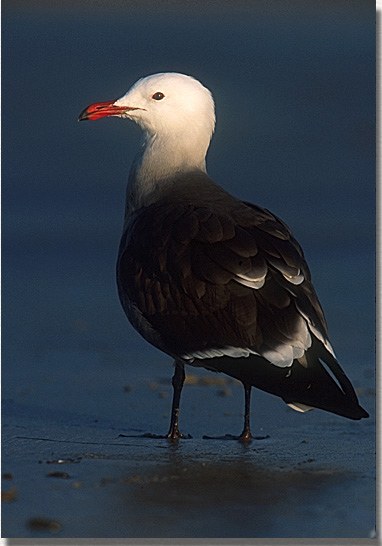
Heermann's Gull
- Habitat
- Pacific coast beaches, rocky shorelines, and harbors
- Size
- About 18-21 inches long
- Lifespan
- Reported to live around 24 years in the wild, though a precise banding longevity record is less well documented than for some other gulls
- Diet
- Fish, often stolen from Brown Pelicans, along with invertebrates and scavenged food
About the Heermann's Gull
Heermann's Gull is one of the more distinctive gulls of the Pacific coast, with slate-gray body plumage, a white head that turns gray-brown outside the breeding season, a dark tail, and a bright red bill tipped in black. Its overall gray tone, rather than the typical white-and-gray pattern of most gulls, makes it easy to pick out in mixed flocks, and its dark body combined with a bright bill gives it one of the more elegant, almost tropical-looking silhouettes of any regularly occurring North American gull.
This species has one of the most concentrated breeding distributions of any North American bird: an estimated 90 to 95 percent of the entire world population nests on a single small island, Isla Rasa, in Mexico's Gulf of California. After the March-through-June breeding season, birds disperse northward along the Pacific coast as far as British Columbia and southward into Mexico, a pattern of post-breeding dispersal rather than a true north-south migration. It is a species of the Pacific coastline and would be an accidental, out-of-range vagrant anywhere in landlocked Oklahoma.
Heermann's Gulls are notable kleptoparasites, frequently following Brown Pelicans and diving to snatch fish that spill from the pelican's pouch as it surfaces from a plunge-dive, a close feeding association between the two species seen throughout much of their range. This partnership is close enough that Heermann's Gull numbers and breeding timing appear linked to pelican breeding success in some studies, since the gulls rely heavily on the larger bird's fishing efforts. They also catch fish directly, scavenge along beaches and harbors, and will take invertebrates and human food scraps opportunistically.
Because such a large share of the global population depends on a single breeding island, Heermann's Gull is considered especially vulnerable to disturbance, disease outbreaks, or environmental shifts affecting that one site, and warm-ocean anomalies affecting food supply near Isla Rasa have been shown to significantly affect the species' breeding success in some years, making it a useful indicator species for Gulf of California ocean conditions. Mexican authorities protect Isla Rasa as a nature reserve specifically because of the concentration of breeding seabirds it supports, including this species alongside large colonies of terns.
Outside the breeding season, dispersing birds can range surprisingly far, with some individuals recorded well north of the species' usual wintering areas along the West Coast, though true vagrancy to landlocked states remains exceptionally rare. Immature Heermann's Gulls take a few years to acquire full adult plumage, passing through a series of increasingly gray and paler intermediate plumages, which can make aging individual birds in mixed flocks an identification challenge even for experienced gull watchers along the Pacific coast.
Heermann's Gulls give a range of harsh, barking calls typical of gulls generally, used both to defend a nest site within the crowded colony and to communicate with a mate during courtship feeding, when the male offers regurgitated food to the female as part of pair bonding. Like most gulls, individuals take several years to reach full adult plumage, and the intermediate stages can appear quite dark and mottled compared to the crisp gray-and-white of a mature bird, occasionally causing confusion with other dark-plumaged gull species along the Pacific coast. Nesting on Isla Rasa exposes eggs and chicks to predation from other gulls and occasional avian predators, and the sheer density of the colony, sometimes holding tens of thousands of pairs at once, likely provides some collective defense even as it creates intense local competition for nest space and food. Longevity data for the species is limited compared to more heavily studied gulls, but related large gull species often live into their teens or beyond when they survive the vulnerable first few years, suggesting Heermann's Gull may achieve a similarly long lifespan under favorable conditions.
Frequently asked questions
Where does almost the entire world population of Heermann's Gull breed?
On Isla Rasa, a small island in Mexico's Gulf of California, which hosts roughly 90 to 95 percent of the global population.
Would you expect to see a Heermann's Gull in Oklahoma?
No, it is strictly a Pacific coast species and would be an extreme rarity anywhere far from the ocean.
What is a Heermann's Gull's relationship with Brown Pelicans?
It frequently steals fish scraps from pelicans as they surface from a dive, a well-documented kleptoparasitic habit tied closely to pelican fishing success.
Why is Heermann's Gull considered vulnerable despite a large population?
Because so much of the species breeds at one single island site, any disturbance or environmental problem there could affect the whole population.
Is Isla Rasa protected?
Yes, Mexican authorities protect it as a nature reserve because of the huge concentration of breeding seabirds, including Heermann's Gull, that depend on it.
Where to find it
This species favors wetland habitat. See real Oklahoma locations on the Habitats map.