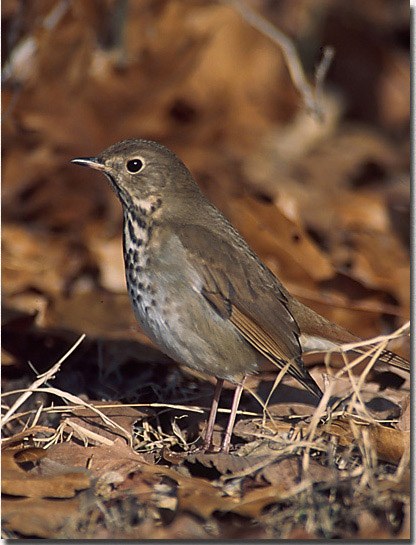
Hermit Thrush
- Habitat
- Mixed forests, coniferous forests, sphagnum bogs, pine barrens, thickets
- Size
- 6½–7½ in, smaller than a robin
- Lifespan
- Oldest banded individual reached almost 11 years; typical wild lifespan is considerably shorter.
- Diet
- Fruit, insects including spiders, earthworms, small salamanders; much fruit especially in winter
About the Hermit Thrush
The Hermit Thrush is a modestly sized songbird, 6½ to 7½ inches long and smaller than an American Robin, with dull brown upperparts, a subtly spotted breast, and a distinctly rusty tail that contrasts with the rest of its otherwise understated plumage. A crisp white eye ring gives the face an alert, wide-eyed expression, and the bird frequently flicks its tail up and slowly down while perched, a habit that helps separate it from similar-looking thrush species sharing the same woodland habitat, including the Swainson's and Gray-cheeked Thrush, both of which lack the contrasting rusty tail.
This thrush favors mixed and coniferous forests, sphagnum bogs, pine barrens, and dense thickets, generally staying in shadier, more sheltered habitat than some of its more open-country relatives. Hermit Thrushes are ground foragers by habit, hopping and pausing through leaf litter in search of food, and they tend to be shy and wary birds, more often heard than seen as they slip quietly through the undergrowth. The male's song is frequently singled out as one of the most beautiful in North American birdlife, a clear, flute-like series of phrases that rise and fall through different pitches, often delivered at dusk from a hidden perch deep in the forest, and each male typically sings several distinct song types in a loosely repeating sequence rather than a single fixed phrase.
The diet includes fruit and a range of invertebrates such as spiders, earthworms, and even small salamanders, with fruit becoming especially important during the winter months when insect activity drops off. One notable and somewhat unusual behavior recorded in the species is anting, in which a bird picks up ants and rubs them on its feathers, or allows ants to crawl over its plumage, a practice thought to help control parasites using the formic acid ants secrete.
Unlike most of its close thrush relatives, which withdraw entirely to Central America for the winter, the Hermit Thrush is unusual in wintering within the United States, a trait that lets birders encounter the species even in the colder months when most other migratory thrushes have moved much further south. This hardiness likely relates to its flexible, fruit-heavy winter diet, which allows it to find enough food even as insects become scarce, and wintering birds in Oklahoma often turn up in wooded ravines, cedar thickets, and brushy edges where berries persist into the cold months.
Longevity records show the oldest banded Hermit Thrush reaching almost 11 years old, though the typical wild lifespan for such a small songbird is considerably shorter given the many hazards of migration, predation, and harsh weather. Nesting habits also vary somewhat by region: birds in some parts of the range nest on the ground under low cover, while others place nests up in the lower branches of a conifer, a flexibility in nest placement not shared by all of its thrush relatives.
Predators of the Hermit Thrush include snakes, small mammals, and various forest hawks, and the species' habit of foraging quietly close to cover likely helps it avoid many of these threats most of the time. Across the western mountains, a number of subspecies are recognized, varying somewhat in overall size and the warmth of the brown upperparts, with some high-elevation populations notably smaller and grayer than their eastern counterparts. Migration timing tends to place the Hermit Thrush among the earliest thrushes to arrive on breeding grounds in spring and among the latest to depart in fall, consistent with its greater winter hardiness compared to close relatives like the Swainson's Thrush, which push much farther south and correspondingly migrate on a tighter schedule tied to tropical wintering conditions.
Frequently asked questions
How do you identify a Hermit Thrush?
Look for dull brown upperparts, a rusty tail, a white eye ring, and frequent tail-flicking while perched.
Where does the Hermit Thrush live?
It lives in mixed and coniferous forests, sphagnum bogs, pine barrens, and thickets.
What makes the Hermit Thrush unusual among thrushes?
Unlike most related thrushes that winter in Central America, it winters within the United States, including in Oklahoma's wooded ravines and cedar thickets.
What is anting, and does the Hermit Thrush do it?
Anting is when a bird rubs ants on its feathers or lets ants crawl over it, likely to fight parasites, and it has been observed in the Hermit Thrush.
Where does a Hermit Thrush build its nest?
Nest placement varies by region, with some birds nesting on the ground under low cover and others placing the nest in the lower branches of a conifer.
Where to find it
This species favors forest habitat. See real Oklahoma locations on the Habitats map.