Hooded Merganser
- Habitat
- Uncommon; breeds on secluded small lakes, ponds, swamps, fast-flowing streams/rivers in wooded areas; winters on large lakes, rivers, coastal brackish lagoons and estuaries, rarely salt water
- Size
- 16–19 in (no wingspan given)
- Lifespan
- Oldest banded bird lived about 14.5 years, though most wild individuals likely live far fewer years.
- Diet
- Mostly fish, also crustaceans, insects, some lower vertebrates and mollusks
About the Hooded Merganser
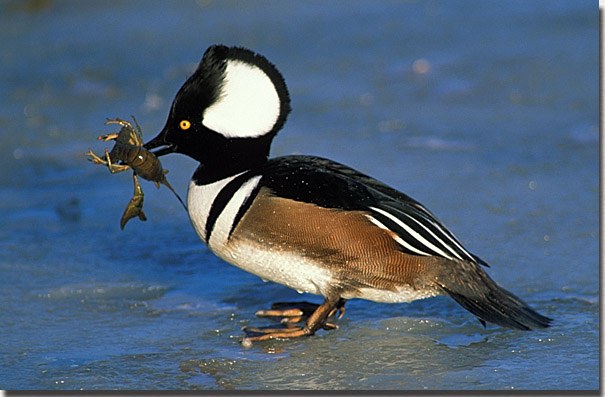
The Hooded Merganser is a small, striking diving duck, 16 to 19 inches long, best known for the male's dramatic fan-shaped crest, which is white bordered by black and can be raised into a bold half-circle or flattened down depending on the bird's mood. Beyond the crest, males show a blackish body, rich rusty flanks, and a clean white breast, a combination that makes a displaying male one of the more visually striking waterfowl in North America. Females are far more subdued, cloaked in soft grayish-brown tones with a smaller, shaggier crest of their own.
This is an uncommon species compared to many other North American ducks, and it has fairly specific habitat needs across the year. Breeding birds seek out secluded small lakes, ponds, swamps, and fast-flowing streams and rivers running through wooded country, habitat that offers both good fish-hunting water and suitable tree cavities for nesting nearby. In winter the birds shift to larger lakes, rivers, and coastal brackish lagoons and estuaries, only rarely venturing onto open salt water.
As a diving duck, the Hooded Merganser feeds mostly on fish, supplementing this core diet with crustaceans, insects, and a scattering of other lower vertebrates and mollusks picked up while diving and swimming underwater. Its narrow, serrated bill is well suited to gripping slippery prey, a family trait shared with other mergansers.
Hooded Mergansers are typically seen in pairs or small flocks rather than the large rafts formed by some other diving ducks, and their flight is notably swift and silent, a contrast to the noisier wingbeats of many other waterfowl. Underwater, the species relies on sharp eyesight to spot fish in often murky, wooded ponds and streams, aided by a specialized nictitating membrane that acts almost like a built-in pair of goggles, protecting the eye while still allowing the bird to track prey as it swims. Females nesting in tree cavities will perform distraction displays to draw predators away from a nest of eggs or young, a defensive behavior shared with several other cavity-nesting duck species. Ducklings, like those of other cavity-nesting waterfowl, must leap from the nest hole to the ground or water within a day or so of hatching, an abrupt but remarkably survivable drop for such small birds. Banding records show the oldest known Hooded Merganser reaching about 14.5 years, though most wild individuals almost certainly live considerably shorter lives given typical waterfowl mortality.
Frequently asked questions
What does a male Hooded Merganser look like?
It has a distinctive white, black-bordered fan-shaped crest, a blackish body, rusty flanks, and a white breast.
Where do Hooded Mergansers breed?
They breed on secluded small lakes, ponds, swamps, and fast-flowing wooded streams and rivers.
What do Hooded Mergansers eat?
Mostly fish, along with crustaceans, insects, and some lower vertebrates and mollusks.
How do female Hooded Mergansers protect their nests?
They perform distraction displays to lure predators away from the nest.
Where to find it
This species favors wetland habitat. See real Oklahoma locations on the Habitats map.