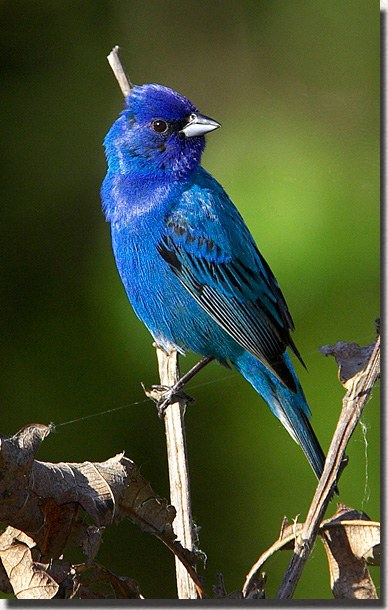
Indigo Bunting
- Habitat
- Brushy old fields, woodland edges, and roadsides with scattered shrubs
- Size
- About 4.7-5.1 inches long
- Lifespan
- The oldest banded individual on record reached at least 13 years, 3 months, well beyond the average lifespan of a small songbird
- Diet
- Seeds and insects, with insects making up a larger share of the diet during the breeding season
About the Indigo Bunting
The breeding male Indigo Bunting is one of the most vivid songbirds in Oklahoma, appearing an almost electric blue in good light, though the color comes not from pigment but from microscopic feather structures that scatter light. Females and non-breeding males, by contrast, are a plain warm brown, sometimes showing faint blue tinges in the wings and tail, making the sexes look almost like different species for part of the year.
Indigo Buntings breed across the eastern and central United States, including throughout Oklahoma, favoring brushy, weedy edge habitat such as overgrown fields, roadsides, power-line cuts, and forest margins rather than deep forest interior or manicured lawns. They winter primarily in southern Mexico, Central America, and the Caribbean.
During the breeding season the diet leans heavily on insects and spiders, an important protein source for growing young, while seeds and berries make up more of the diet during migration and winter. Buntings forage low in vegetation and on the ground, gleaning food from grass seed heads, shrubs, and leaf litter.
Male Indigo Buntings are notable for learning their song by listening to neighboring males shortly after settling on a first territory, which produces local song "dialects" that can persist among neighboring males for years, a well-studied example of vocal culture in a wild songbird population. The species is also known for its role in classic studies of celestial navigation, since young buntings raised in a planetarium were shown to orient their migratory direction using the pattern of stars around the North Star, demonstrating that the birds learn to use the night sky as a migratory compass rather than being born with it fixed.
Where the range of the Indigo Bunting meets that of the closely related Lazuli Bunting farther west, the two species can interbreed, producing hybrid offspring with intermediate plumage traits, a contact zone that has made the pair a useful subject for studying how closely related bird species remain distinct or blend where their ranges overlap. Indigo Buntings remain common and widespread across Oklahoma in summer, and their persistent, cheerful, paired-phrase song, often described as if the bird is repeating each note twice, is one of the most familiar sounds of brushy fields and roadsides through the warmer months.
Frequently asked questions
Why does the male Indigo Bunting look blue if it has no blue pigment?
Its feather structure scatters light in a way that produces blue color, a structural effect rather than a pigment-based one.
Do male and female Indigo Buntings look alike?
No, males are vivid blue during the breeding season while females and non-breeding males are plain brown.
What kind of habitat do Indigo Buntings prefer?
Brushy, weedy edge habitat like overgrown fields, roadsides, and woodland margins, rather than dense forest interior.
How do young Indigo Buntings learn to navigate during migration?
Studies show they learn to orient using the rotating pattern of stars in the night sky around the North Star.
Where to find it
This species favors forest habitat. See real Oklahoma locations on the Habitats map.