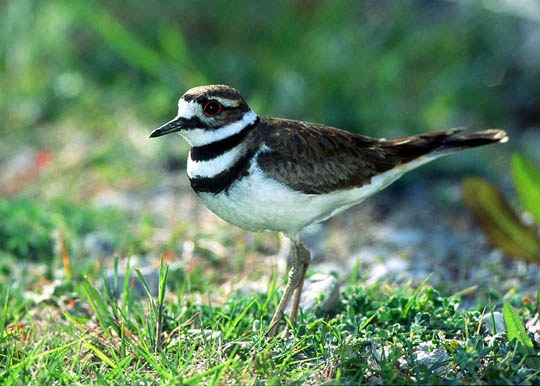
Killdeer
- Habitat
- Common and vocal on open grassy fields, lawns, airports, meadows, farm fields, shores, riverbanks
- Size
- 9–11 in, the largest ringed plover
- Lifespan
- Typical wild lifespan is about 3-5 years; oldest banded individual lived nearly 11 years.
- Diet
- Mostly insects, an assortment of invertebrates, weed seeds
About the Killdeer
The Killdeer is a common, vocal shorebird, 9 to 11 inches long, notable as the largest of the ringed plovers found in North America. It shows the classic plover build: a compact body, large dark eyes, and two black breast bands crossing an otherwise brownish-gray back and clean white underparts, a bold pattern that stands out clearly even at a distance on open ground. In flight, a bright orange-buff rump becomes visible, an easily missed field mark that flashes clearly the moment a standing bird takes off.
Unlike many shorebirds tied closely to shoreline habitat, Killdeer thrive in a wide range of open, grassy environments far from any body of water, including lawns, athletic fields, airports, meadows, and farm fields, in addition to more traditional shorebird habitat along riverbanks and shores. Their loud, piercing call, which sounds like a repeated 'kill-deer,' is often the first sign of a bird's presence, since the species tends to fly alone in an erratic, seemingly haphazard pattern rather than in the tight, drilled flocks of many other shorebirds.
The diet consists mostly of insects along with an assortment of other invertebrates and some weed seeds, gathered by walking and pausing across open ground in a typical plover foraging style, watching for movement before dashing forward to seize prey. This diet of agricultural pest insects makes the Killdeer a generally welcome presence on farmland, where it can consume substantial numbers of beetles, grubs, and other crop-damaging invertebrates over the course of a season.
Killdeer are best known for their dramatic broken-wing display, in which an adult feigns a damaged wing and drags it along the ground while moving away from the nest, drawing a predator's attention away from eggs or chicks hidden in a shallow ground scrape nearby. The nest itself is barely a nest at all, just a shallow depression scraped into bare gravel or dirt, and the eggs are heavily mottled in a pattern that camouflages them remarkably well against the surrounding stones. The birds are easily alarmed and quick to react to any perceived threat near the nest, and males are notably fierce in defending the nest site, sometimes confronting animals or people many times their own size; when a threat is a grazing animal rather than a predator, the parent may instead fluff up and run directly at the intruder's face in an aggressive display meant to redirect its path away from the eggs.
Chicks are precocial, able to walk and feed themselves within hours of hatching, following the adults away from the nest almost immediately rather than staying put to be fed. Typical wild lifespan runs about 3 to 5 years, though the oldest banded individual on record lived nearly 11 years, a solid outcome for a small ground-nesting bird facing constant exposure to predators and human disturbance in the open habitats it favors.
Beyond its namesake call, the Killdeer gives a range of other vocalizations, including a rapid, agitated trill when a predator or intruder approaches too closely to a nest, and a softer contact call exchanged between members of a pair or family group moving together across open ground. Predators of eggs and chicks include snakes, various mammals, and other birds, and the excellent camouflage of the mottled eggs represents the species' primary defense given how exposed a bare-ground nest scrape necessarily is. Killdeer are only partial migrants, with northern populations withdrawing south for the winter while birds in much of Oklahoma and other mid-latitude states may remain year-round, making the species one of the earliest shorebirds back on territory each spring and among the last to depart in fall.
Frequently asked questions
Why is the Killdeer called by that name?
Its name comes from its loud, distinctive call, which sounds like a repeated 'kill-deer.'
Does the Killdeer only live near water?
No, it commonly lives in open grassy areas like lawns, airports, meadows, and farm fields, in addition to shores and riverbanks.
How does a Killdeer protect its nest?
It performs a broken-wing display, feigning injury to lure predators away from its ground nest, and males fiercely defend the nest site.
What does a Killdeer eat?
Mostly insects, along with other invertebrates and some weed seeds, including many crop pests that make it beneficial on farmland.
Does a Killdeer react differently to a grazing cow than to a predator?
Yes, against a large grazing animal it may skip the broken-wing act and instead run directly at the animal's face to redirect it away from the nest.
Where to find it
This species favors grassland habitat. See real Oklahoma locations on the Habitats map.