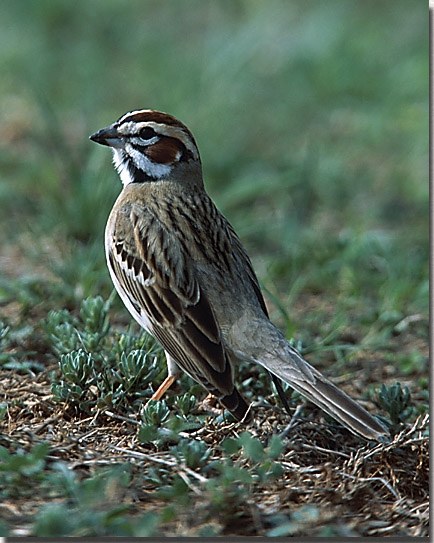
Lark Sparrow
- Habitat
- Open grasslands with scattered shrubs or trees, savanna, and agricultural edges
- Size
- About 5.9-6.7 inches long
- Lifespan
- The oldest banded individual on record was at least 9 years, 11 months old
- Diet
- Seeds and insects
About the Lark Sparrow
The Lark Sparrow stands out among North American sparrows for its bold, harlequin-like facial pattern: chestnut and white stripes on the head, a white eye ring, and a black whisker mark, combined with a long tail edged in white that is easy to spot when the bird flushes and fans it in flight. Its breast typically shows a single dark central spot on an otherwise clean, pale background, a mark shared with only a handful of other North American sparrows and useful for confirming identification once the bold head pattern has already caught the eye.
It favors open habitats with a mix of bare ground, grass, and scattered trees or shrubs, including savanna, pastures, roadsides, and agricultural edges, and it breeds across much of Oklahoma and the central and western United States. It is more tolerant of scattered woody vegetation than many other grassland sparrows, which lets it use a broader range of semi-open habitats, from rural roadside verges to open oak savanna, more readily than more strictly grassland-bound species like the Grasshopper Sparrow.
Lark Sparrows forage mainly on the ground, walking and hopping to pick up seeds and insects, with grasshoppers and other insects especially important during the breeding season to feed nestlings, while seeds make up a larger share of the diet the rest of the year. Outside the breeding season, birds often gather into loose flocks that forage together across open fields and roadside habitat, sometimes mixing with other open-country sparrows during migration.
The species has an unusual courtship display among sparrows: males perform an elaborate ground display in front of a female, strutting with wings drooped and tail spread and raised, sometimes even offering a small twig or piece of grass in the bill. Lark Sparrows are also occasionally recorded practicing a loose, informal cooperative arrangement where a male may help a nesting pair, though the species is not considered a fully cooperative breeder like Harris' Hawk. Populations across parts of its range have declined somewhat with the loss of open grassland and pasture habitat, though it remains a fairly widespread and recognizable bird across Oklahoma's rural landscape.
The species' song is notably varied and musical for a sparrow, often combining clear whistled notes, buzzy trills, and short pauses in a pattern distinct enough that some early ornithologists compared it favorably to the songs of true larks, which may have contributed to its common name despite the bird not being closely related to true larks at all. Lark Sparrows are present across most of Oklahoma during the breeding season and withdraw largely to the southern United States and Mexico in winter, making them a familiar warm-season bird of pastures, roadsides, and open rural land throughout the state.
Predators of the Lark Sparrow's ground nest include snakes, various small mammals, and grassland-hunting birds, and the species relies heavily on the concealing effect of grass and low shrub cover rather than any active nest defense beyond alarm calling when a threat approaches. Two subspecies are generally recognized across the bird's range, an eastern form and a paler, slightly different western form found across much of the Great Plains and westward, though the differences are subtle enough that most birders do not attempt to distinguish them in the field. Beyond its full song, the Lark Sparrow gives a variety of shorter contact and alarm calls used to keep a foraging flock loosely coordinated outside the breeding season, when family groups and migrating flocks often move together across open pasture and roadside habitat in search of seed.
Frequently asked questions
What is the most distinctive feature of a Lark Sparrow?
Its bold chestnut-and-white harlequin facial pattern, unlike the more uniform faces of most other sparrows.
What kind of habitat does the Lark Sparrow prefer?
Open grassland with scattered shrubs or trees, such as savanna, pasture, and agricultural edges.
How does a male Lark Sparrow court a female?
With an elaborate ground display, strutting with drooped wings and a raised, fanned tail, sometimes offering a twig.
What does the Lark Sparrow eat?
A mix of seeds and insects, with insects more important during the breeding season.
Does the Lark Sparrow flock with other sparrows?
Outside the breeding season it often forms loose foraging flocks in open fields and roadside habitat, sometimes alongside other open-country sparrows during migration.
Where to find it
This species favors grassland habitat. See real Oklahoma locations on the Habitats map.