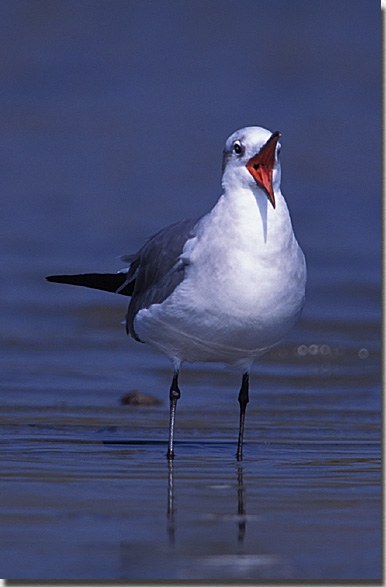
Laughing Gull
- Habitat
- Coastal beaches, salt marshes, and harbors, with inland occurrences during migration or wandering
- Size
- About 16-17 inches long
- Lifespan
- The oldest banded individual on record reached at least 22 years old
- Diet
- Fish, invertebrates, insects, and scavenged food, including items stolen from other birds or people
About the Laughing Gull
The Laughing Gull is a medium-sized gull best known for breeding plumage that includes a solid black hood, dark gray back and wings, white underparts, and a deep red bill, with the hood fading to a smudged gray-and-white pattern in winter. Its common name comes from its loud, laughing-sounding call, a series of nasal, cackling notes often given in flight, and the same raucous calling is a familiar soundtrack at beaches and boardwalks throughout its coastal breeding range.
It is primarily a bird of the Atlantic and Gulf coasts of the United States, nesting in colonies on coastal islands and salt marshes and ranging along beaches, harbors, and estuaries. Away from the coast, Laughing Gulls occur less predictably; in an inland state like Oklahoma, sightings are uncommon and tend to involve wandering individuals turning up at large reservoirs, especially after storms or during migration.
As an opportunistic feeder, the Laughing Gull eats a wide variety of food: it catches fish near the surface, picks up crabs and other invertebrates along shorelines, and readily scavenges scraps from beaches, fishing boats, and picnic areas. It is also a persistent kleptoparasite, chasing terns and pelicans to steal freshly caught fish, and has become notably bold around humans in beach towns where food is easy to obtain, sometimes snatching food directly from an unguarded hand or picnic table.
Laughing Gulls nest in dense colonies, sometimes numbering thousands of pairs, on protected coastal islands and marsh habitat, building a simple nest scrape lined with grasses. This colonial nesting offers safety in numbers against predators, and the species' adaptability to human-altered coastal environments, along with its comfort scavenging around people, has helped it remain common along much of its coastal range even as some other coastal-nesting birds have declined. Within a colony, pairs defend only a small territory immediately around the nest scrape, tolerating close neighbors in exchange for the shared vigilance and predator-swamping benefits of nesting in a large group.
Young Laughing Gulls take a few years to reach full adult plumage, passing through progressively grayer and whiter immature stages that can make them tricky to distinguish from other gull species until they mature. In an inland state like Oklahoma, most records tend to follow major weather systems such as tropical storms, which can displace coastal birds well inland, making the species a good example of how large-scale weather events can temporarily reshape which birds show up far from their usual range.
Courtship in the Laughing Gull involves the male offering regurgitated food to a prospective mate, a behavior called courtship feeding shared with many other gull species, which may help a female assess a potential partner's foraging skill before committing to a pair bond for the season. Young gulls take about three years to reach full adult plumage, passing through a mottled brown juvenile stage and progressively grayer immature plumages before acquiring the crisp black hood and gray back of a breeding adult. Predators and threats to nesting colonies include raccoons, foxes, and other mammals capable of reaching coastal islands, as well as periodic flooding from storm surge that can wipe out an entire season's nesting effort in low-lying marsh colonies. Longevity records for the species show individuals living close to 20 years in the wild, a solid lifespan reflecting the relative safety colonial nesting and a flexible, opportunistic diet can provide once a bird survives its first few uncertain years. The species has also expanded its range somewhat in recent decades, establishing new colonies in areas where suitable protected coastal habitat and food supply allow, a pattern of modest range growth that contrasts with the declines seen in some other coastal-nesting seabirds.
Frequently asked questions
Why is it called the Laughing Gull?
Its loud, cackling call is thought to sound like laughter, giving the species its common name.
Is the Laughing Gull common in Oklahoma?
No, it is primarily a coastal bird, and inland sightings in Oklahoma are uncommon, usually involving wandering individuals, often after tropical storms.
How aggressive is the Laughing Gull about getting food?
It is a bold scavenger and kleptoparasite, often stealing fish directly from terns, pelicans, or unattended food at beaches.
Does the Laughing Gull nest alone or in groups?
It nests in dense colonies on protected coastal islands and marshes, sometimes with thousands of pairs together.
Why do inland sightings of Laughing Gulls often follow storms?
Large tropical storms can displace coastal birds well inland, temporarily carrying Laughing Gulls far from their normal coastal range.
Where to find it
This species favors wetland habitat. See real Oklahoma locations on the Habitats map.