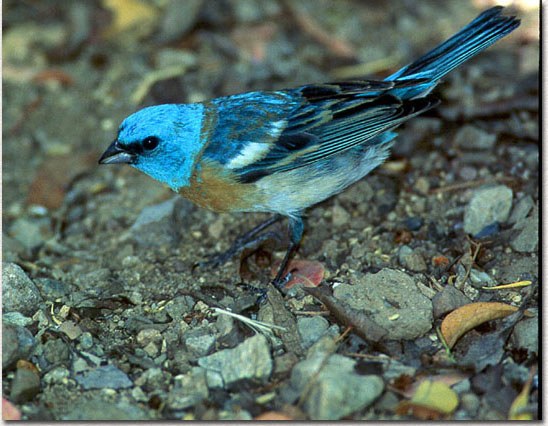
Lazuli Bunting
- Habitat
- Open brushy areas, weedy areas, open deciduous woodlands (aspen, willows, alders, cottonwood), chaparral, scrublands, shrubs near streams
- Size
- 5–5¼ in, sparrow-sized
- Lifespan
- Oldest banded individual reached about 9 years old in the wild.
- Diet
- Insects, seeds
About the Lazuli Bunting
The Lazuli Bunting is a small, sparrow-sized songbird, only about 5 to 5¼ inches long, but one of the more visually striking small birds in western North America. Breeding males are a brilliant sky blue over the head, back, and wings, offset by a warm cinnamon wash across the breast and a clean white belly, a combination that makes a male in good light hard to mistake for anything else. Females are far more subdued, wearing plain dull brown plumage that offers much better camouflage while incubating eggs or tending young in exposed shrubby nest sites, though even females often show a faint hint of blue in the wings and tail visible at close range.
This species favors open, brushy country, including weedy fields, chaparral, and scrublands, along with open deciduous woodland featuring aspen, willows, alders, or cottonwood, and shrubby growth along streams. That preference for a mix of open ground and scattered woody cover puts it at home across a wide swath of the interior West, from foothill canyons to streamside thickets, and it overlaps and occasionally hybridizes with the closely related Indigo Bunting in a narrow zone across the Great Plains, including parts of Oklahoma.
The diet is a fairly even mix of insects and seeds, shifting somewhat by season as insect abundance rises and falls, a common pattern among small seed- and insect-eating songbirds that need protein-rich insect prey during the breeding season but can rely more on seeds at other times of year.
Outside the breeding season, Lazuli Buntings commonly gather into flocks and move to higher elevations once nesting duties are finished, taking advantage of seasonal food resources higher in the mountains before continuing their migration. During migration, the species is frequently seen associating with Chipping Sparrows and various finches, forming loose mixed-species flocks that may offer some safety in numbers or simply reflect shared habitat preferences along the migratory route. Young males do not hatch already knowing their song; instead they piece it together during their first spring by borrowing and recombining phrases from older males already holding territory nearby, so that a given area often develops its own local song pattern shared among neighboring males, a phenomenon researchers have used the species to study in some detail because each local dialect can persist for years.
The oldest banded Lazuli Bunting on record reached about 9 years old, a solid lifespan for such a small songbird given the annual hazards of long-distance migration.
Females build a compact, cup-shaped nest low in a shrub or dense grass clump, weaving grass, bark strips, and rootlets together and lining the interior with fine grass or hair, work that typically takes the female several days to complete while the male remains nearby, singing and defending the surrounding territory. Predators of eggs and nestlings include snakes, small mammals, and various birds, and nest success can vary considerably from year to year depending on local predator abundance and how well the chosen shrub conceals the nest from view. Brown-headed Cowbirds occasionally parasitize Lazuli Bunting nests, laying an egg for the bunting pair to unwittingly raise alongside or instead of their own young, a pressure the species shares with many other open-country songbirds across the West. Populations have remained relatively stable across most of the Lazuli Bunting's range, in contrast to some of the more steeply declining grassland and shrubland specialists, likely helped by the bird's tolerance of a fairly wide range of brushy and semi-open habitats rather than dependence on a single, increasingly rare vegetation type. Adult males typically return to the same general breeding area in successive years, a site fidelity that helps maintain the local song dialects the species is known for among researchers.
Frequently asked questions
What does a male Lazuli Bunting look like?
It is bright blue on the head, back, and wings, with a cinnamon breast and white belly.
Where does the Lazuli Bunting live?
It lives in open brushy areas, chaparral, and open deciduous woodland with aspen, willows, alders, or cottonwood.
Does the Lazuli Bunting flock with other species?
Yes, during migration it often associates with Chipping Sparrows and other finches.
What do Lazuli Buntings eat?
They eat a mix of insects and seeds, shifting toward more insects during the breeding season.
Does the Lazuli Bunting interbreed with the Indigo Bunting?
Yes, the two species overlap and occasionally hybridize in a zone across the Great Plains, including parts of Oklahoma.
Where to find it
This species favors forest habitat. See real Oklahoma locations on the Habitats map.