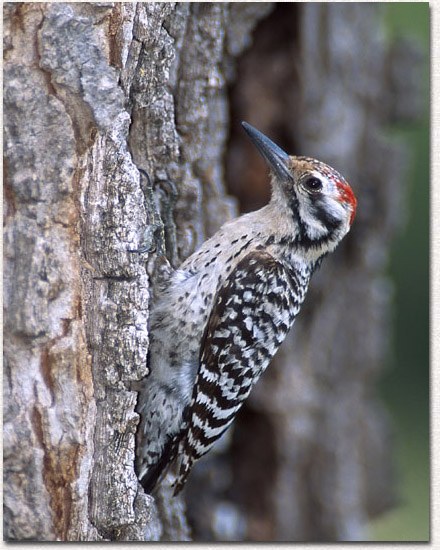
Ladder-backed Woodpecker
- Habitat
- Scrublands at deserts' edge, cottonwood groves, brushy areas along small streams, wooded canyons, brushlands with cactus/mesquite, rural areas, towns, parks
- Size
- 7 in
- Lifespan
- Oldest banded record is about 4.5 years, suggesting a fairly short typical wild lifespan.
- Diet
- Fruit, including especially cactus (the page's exact, terse diet line)
About the Ladder-backed Woodpecker
The Ladder-backed Woodpecker is a small woodpecker, about 7 inches long, whose common name refers to the finely barred black-and-white pattern running down its back, which resembles the rungs of a ladder when seen up close. A strong black-and-white pattern also marks the face, and, as in many woodpeckers, the sexes are distinguished by the crown color: males show a bright red cap, while females carry a plain black one instead. In the field it can be confused with the slightly larger Downy Woodpecker where their ranges meet, but the Ladder-backed's barred back, more extensively patterned face, and preference for arid scrub rather than moist woodland usually settle the question; farther west, its near-twin the Nuttall's Woodpecker takes over in California chaparral, and the two species were once considered close enough that early ornithologists debated their exact relationship.
This species occupies much the same range of semi-arid and scrubby habitats as its close relative the Golden-fronted Woodpecker, including scrublands at the desert's edge, cottonwood groves, brushy corridors along small streams, wooded canyons, and brushlands thick with cactus and mesquite. It has also settled comfortably into rural areas, towns, and parks, taking advantage of scattered trees and structures for both foraging and nesting even in fairly developed landscapes. Utility poles, fence posts, and dead orchard limbs all serve as acceptable substitutes for the natural dead wood the species prefers, which has helped it persist even as some of its native brushland habitat has been cleared or fragmented over time.
Like its relative, fruit forms an important part of the diet, with cactus fruit standing out as an especially favored food source in the arid country the species calls home. One notable behavioral trait sets the Ladder-backed Woodpecker apart from many of its tree-dwelling relatives: it often feeds on the ground, a habit less commonly seen among woodpeckers, which typically forage on trunks and branches well above the forest floor. Much of its insect prey, including beetle larvae and ants, is gleaned from the soft, sun-baked wood of dead mesquite and cactus limbs, which the bird can excavate far more easily than the dense hardwood favored by larger woodpeckers, letting a comparatively small bill do the work of a much bigger one.
As cavity nesters, Ladder-backed Woodpeckers excavate holes in trees, large cacti such as saguaro or yucca stalks, or dead wood, providing shelter not only for their own young but potentially for other cavity-dependent wildlife afterward, including small owls, flycatchers, and other secondary cavity-nesting birds that cannot excavate their own holes. Both parents typically share incubation and feeding duties, and the young remain in the nest for several weeks before fledging, continuing to beg for food from the adults for a short period even after leaving the cavity. Like other woodpeckers, the species communicates through drumming as well as calls, rattling its bill against a resonant surface to advertise a territory across the open, sparsely wooded country it favors, and its sharp, high-pitched calls can carry a surprising distance through the thin desert air.
Banding records for the species are relatively sparse, but the oldest documented individual reached about 4.5 years, suggesting a fairly short typical lifespan in the wild compared to some other small woodpeckers, likely a reflection of the many hazards facing a small bird in harsh desert-edge habitat, including predation by snakes and raptors and the physical stress of extreme heat. It remains a year-round resident across its range rather than a migratory species, holding the same territory through every season, a strategy that works because its varied diet of insects, cactus fruit, and other plant material remains at least somewhat available even during the leanest months of the desert year.
Frequently asked questions
Why is it called the Ladder-backed Woodpecker?
Its name comes from the finely barred black-and-white pattern on its back, which resembles a ladder's rungs.
How do you tell male and female Ladder-backed Woodpeckers apart?
Males have a red cap while females have a black cap.
Does the Ladder-backed Woodpecker feed on the ground?
Yes, unlike many woodpeckers, it often feeds on the ground.
Where does the Ladder-backed Woodpecker live?
It lives in desert-edge scrublands, cottonwood groves, wooded canyons, and cactus-mesquite brushlands, as well as rural areas and parks.
How can you tell a Ladder-backed Woodpecker from a Downy Woodpecker?
The Ladder-backed's barred back and more heavily patterned face separate it from the Downy Woodpecker, and the two species generally favor different habitats, with the Ladder-backed sticking to arid scrub rather than moist woodland.
Where to find it
This species favors grassland habitat. See real Oklahoma locations on the Habitats map.