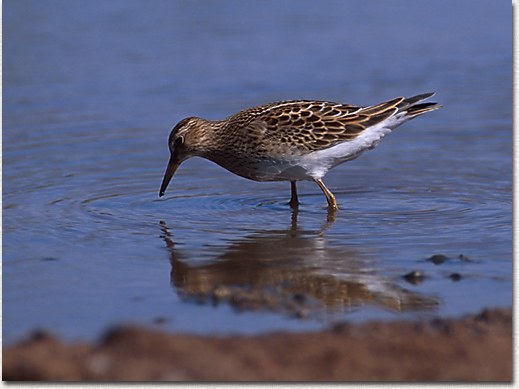
Least Sandpiper
- Habitat
- Wet muddy areas, grassy areas, wet short grasses of salt marshes, tidal flats, sloughs, muddy lake shores, sandy/gravel beaches; nests on subarctic tundra
- Size
- 5½–6 in (no wingspan given)
- Lifespan
- Typically lives 3-5 years in the wild; one exceptional banded bird reached 15-16 years.
- Diet
- Insects, aquatic invertebrates, seeds, also crustaceans, worms, mollusks
About the Least Sandpiper
The Least Sandpiper is a tiny shorebird, only 5½ to 6 inches long, widely regarded as the smallest sandpiper in the world, smaller even than the similarly diminutive Semipalmated Sandpiper with which it often associates on migration. In summer plumage the back and breast show dark brown streaking, while winter birds turn noticeably grayer and plainer overall. Distinctive yellowish-green legs set it apart from many similar small sandpipers, which typically show darker legs, and a short, gently downward-curved bill rounds out the field marks that help separate this species from its close relatives; in mixed flocks of "peeps," as birders often call this confusing group of small sandpipers, leg color is frequently the single most reliable field mark once light and mud have obscured everything else.
Least Sandpipers nest far to the north, on subarctic tundra, but spend much of the rest of the year on a wide variety of muddy and wet habitats further south, including wet grassy areas, the short wet grasses of salt marshes, tidal flats, sloughs, muddy lake shores, and sandy or gravel beaches. This flexibility in non-breeding habitat helps explain why the species turns up reliably at so many different kinds of wetland stopover sites during migration, from small farm ponds and roadside ditches in the interior United States to expansive coastal mudflats, wherever a patch of soft mud or shallow water offers a place to feed.
Foraging Least Sandpipers pick and probe for insects, aquatic invertebrates, crustaceans, worms, and mollusks in soft mud and shallow water, along with a smaller portion of seeds, typically working the shoreline in loose, actively feeding groups. Unlike some larger sandpipers that wade into deeper water, this species tends to stay on drier mud just above the waterline, using its short bill to pick prey from the surface rather than probing deeply, a foraging niche that helps reduce direct competition with larger shorebirds feeding nearby. On the breeding grounds, both parents share incubation duties, and chicks are precocial, able to walk and feed themselves within hours of hatching, though they still depend on a parent for warmth and protection from predators during their first days.
The species has earned a reputation as, in the words of one common description, the tamest of shorebirds, often allowing surprisingly close approach compared to more skittish shorebird species. In flight it shows extremely rapid wingbeats and a characteristic zigzagging, erratic flight pattern, quite different from the smoother flight lines of larger shorebirds, a maneuver thought to help confuse aerial predators such as Merlins and other small falcons that specialize in hunting shorebirds on migration. Least Sandpipers undertake a long annual migration between the tundra breeding grounds and wintering areas that can stretch as far south as northern South America, typically traveling in tight, fast-moving flocks that wheel and turn in unison over open mudflats and shorelines.
Typical wild lifespan runs 3 to 5 years, but longevity records include one truly exceptional banded bird that reached 15 to 16 years old, a remarkable outlier for a bird so small and seemingly vulnerable to the many risks of long-distance migration. Adult Least Sandpipers molt into a duller nonbreeding plumage before heading south, and juveniles, which fledge with crisp buffy edging on their back feathers, often linger slightly longer on the breeding grounds than adults before beginning their own first southbound journey, a pattern seen in many arctic-breeding shorebirds.
Frequently asked questions
Is the Least Sandpiper really the smallest sandpiper?
Yes, at 5½ to 6 inches, it is considered the smallest sandpiper species.
How can you identify a Least Sandpiper?
Look for yellowish-green legs, a short downward-curved bill, and dark brown streaking above in summer that turns grayer in winter.
Where does the Least Sandpiper nest?
It nests on subarctic tundra, then spends the rest of the year on mudflats, marshes, and beaches further south.
How long can a Least Sandpiper live?
Typically 3 to 5 years, though one exceptional banded bird reached 15 to 16 years.
How can you tell a Least Sandpiper from other small "peep" sandpipers?
Its yellowish-green legs are usually the most reliable field mark, since darker-legged peeps like the Semipalmated Sandpiper can otherwise look very similar.
Where to find it
This species favors wetland habitat. See real Oklahoma locations on the Habitats map.