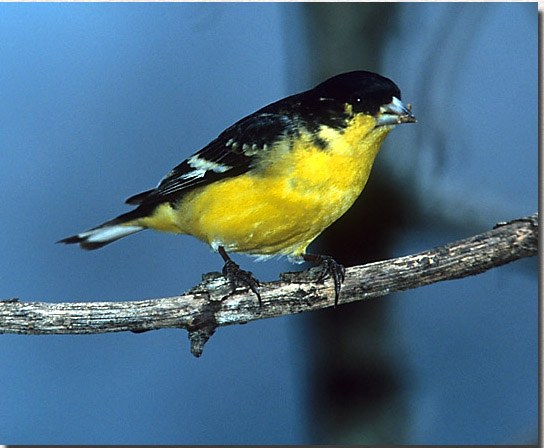
Lesser Goldfinch
- Habitat
- Open woodlands, scrub, weedy fields, and gardens, mostly in the southwestern and south-central United States
- Size
- About 3.5-4.3 inches long, the smallest goldfinch in North America
- Lifespan
- The oldest banded individual on record was 7 years old
- Diet
- Seeds, especially from plants in the sunflower and composite family, with some insects taken as well
About the Lesser Goldfinch
The Lesser Goldfinch is a tiny finch, smaller than the more widespread American Goldfinch, with males showing a black or greenish back, bright yellow underparts, and a black cap, while females are duller olive-yellow overall. Two color forms occur across its range, with males in the east, including Oklahoma and Texas, typically showing a greenish back rather than the solid black back found in the western population, a geographic split that has long interested ornithologists studying how plumage variation can persist across a broad, continuous range without splitting into separate species.
This species reaches the eastern edge of its range in Oklahoma and neighboring states, favoring open woodland edges, brushy scrub, weedy fields, and increasingly gardens and parks with bird feeders, across the southwestern and south-central United States down into Mexico and Central America. It is generally more a bird of the southern and western parts of the state than a statewide resident, and its numbers there can fluctuate somewhat from year to year depending on local seed abundance and the availability of suitable brushy habitat, since the species is quick to abandon an area once its preferred food plants are depleted.
Like other goldfinches, it feeds heavily on small seeds, especially from plants in the sunflower and daisy family such as thistle, sunflower, and various weedy composites, using its short, conical bill to extract seeds directly from the seed head, sometimes clinging upside down to reach them. It supplements this diet with insects, particularly during the breeding season, when the extra protein helps support egg production and rapidly growing nestlings. Lesser Goldfinches also have a notable taste for the seeds of introduced weeds along roadsides and disturbed ground, meaning the species has, if anything, benefited somewhat from human-altered landscapes that produce abundant weedy seed crops.
Lesser Goldfinches are highly social outside the breeding season, often gathering in small flocks at feeders and weedy fields, and their flight call, a distinctive rising and falling series of notes, is frequently used to help identify the species even before it comes into view. Because the species nests relatively late in the season, timed to coincide with peak seed availability from summer-blooming plants, its breeding schedule runs later than many other songbirds in the same region. Males often sing a rambling, somewhat disorganized warbling song from an exposed perch near the nest, and like many finches, they will incorporate fragments of other species' calls into their own song.
Outside the breeding season, Lesser Goldfinches often mix into foraging flocks with American Goldfinches and other small finches, and the two species can sometimes be told apart by size, back color, and voice once observers become familiar with both. Adult males undergo a molt that can make identification tricky at certain times of year, as some individuals show a patchy mix of old and new feathers. Because Oklahoma sits near the eastern edge of the species' range, numbers and reliability of sightings tend to increase toward the western part of the state, and a Lesser Goldfinch found well to the east is often noted as a small local highlight by area birders.
Pairs typically raise their brood in a small, well-hidden cup nest built low in a shrub or sapling, with the female doing most of the construction while the male stands guard nearby and periodically feeds her during the building and incubation period. Because the species is so tied to seed availability, some pairs will attempt a second brood in a single season if conditions remain favorable, taking advantage of an extended supply of ripening thistle and sunflower-family seed heads well into late summer. Like many finches, Lesser Goldfinches are considered somewhat nomadic rather than strictly migratory, shifting locally in response to where seed crops are currently most productive rather than following a fixed north-south route each year.
Frequently asked questions
How does the Lesser Goldfinch compare in size to other goldfinches?
It is the smallest goldfinch species in North America, notably smaller than the more familiar American Goldfinch.
Is the Lesser Goldfinch common throughout Oklahoma?
It is more typical of the southern and western parts of the state, reaching the eastern edge of its overall range there.
What do Lesser Goldfinches mainly eat?
Small seeds, especially from sunflower-family plants like thistle and various weedy composites.
Why does the Lesser Goldfinch nest later than many songbirds?
Its breeding schedule is timed to coincide with peak seed availability from summer-blooming plants.
Do male Lesser Goldfinches always have black backs?
No, only western males typically show a solid black back; males in Oklahoma and the east usually show a greenish back instead.
Where to find it
This species favors grassland habitat. See real Oklahoma locations on the Habitats map.