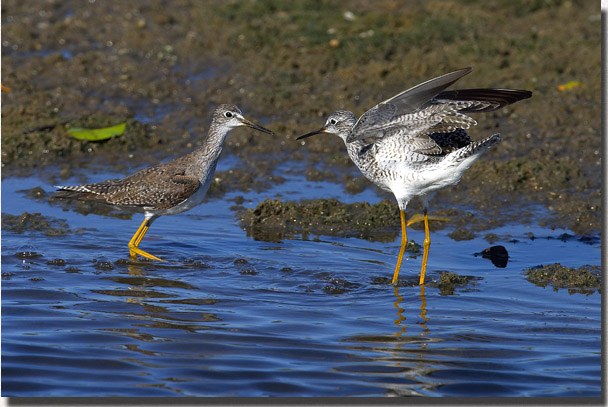
Lesser Yellowlegs
- Habitat
- Shallow wetlands, mudflats, and flooded fields during migration; breeds in boreal forest openings and muskeg far to the north
- Size
- About 9.4-11 inches long, smaller and more compact than the similar Greater Yellowlegs
- Lifespan
- The oldest banded individual on record was at least 4 years, 11 months old, though the true maximum lifespan is likely somewhat higher based on general shorebird survival patterns
- Diet
- Aquatic insects, small crustaceans, and tiny fish
About the Lesser Yellowlegs
The Lesser Yellowlegs is a slender, medium-sized shorebird with bright yellow legs, a straight, needle-thin bill, and mottled gray-brown upperparts. It closely resembles the larger Greater Yellowlegs but is smaller overall, with a shorter, straighter bill roughly equal in length to the head, and a softer, single or double-noted call rather than the Greater's louder, more insistent three-note call.
Lesser Yellowlegs breed in open boreal forest clearings and muskeg across Alaska and Canada, well north of Oklahoma, but the state hosts the species regularly as a migrant, especially during spring and fall, when birds pass through on their way between breeding grounds and wintering areas that stretch from the southern United States down through South America. Migrating birds favor shallow wetlands, flooded fields, mudflats, and the edges of ponds and lakes.
Foraging Lesser Yellowlegs pick and probe for food in shallow water and mud, taking aquatic insects, small crustaceans, and tiny fish, often moving with quick, active steps rather than the slower, more deliberate foraging style of some other shorebirds. They will also snatch flying insects from just above the water surface at times.
Because it nests in remote, difficult-to-access boreal habitat, less is known about the detailed breeding biology of the Lesser Yellowlegs compared to many other North American shorebirds, though its numbers have shown concerning declines in recent decades, likely tied to a combination of habitat changes on its breeding grounds and pressures faced along its long migratory routes and wintering areas, making it a species of increasing conservation attention among shorebird researchers.
Lesser Yellowlegs frequently associate with the larger Greater Yellowlegs during migration, and comparing the two side by side, when both are present, is one of the more reliable ways to appreciate the size and bill-length differences that separate them. Wetlands and flooded agricultural fields across Oklahoma provide important stopover habitat for migrating flocks, offering a chance to rest and feed before continuing on toward wintering grounds that can extend as far south as southern South America.
Like its larger relative, the Lesser Yellowlegs nests on the ground in open boreal habitat and readily gives loud alarm calls when a predator approaches the nest, a defensive strategy shared broadly across the yellowlegs group. Because both yellowlegs species can occur together at the same wetlands during migration, careful observers in Oklahoma often use the pair as a helpful practice case for training their eye on subtle differences in size, bill length, and call between two otherwise very similar-looking shorebirds.
Frequently asked questions
How can you distinguish a Lesser Yellowlegs from a Greater Yellowlegs?
The Lesser is smaller with a shorter, straighter, more needle-like bill and a softer call.
Does the Lesser Yellowlegs breed in Oklahoma?
No, it breeds in boreal forest openings across Alaska and Canada; Oklahoma sees it mainly during migration.
What does a Lesser Yellowlegs eat?
Mostly aquatic insects, small crustaceans, and tiny fish picked from shallow water and mud.
Is the Lesser Yellowlegs population stable?
No, it has shown concerning population declines in recent decades, drawing increased conservation attention.
Where to find it
This species favors wetland habitat. See real Oklahoma locations on the Habitats map.