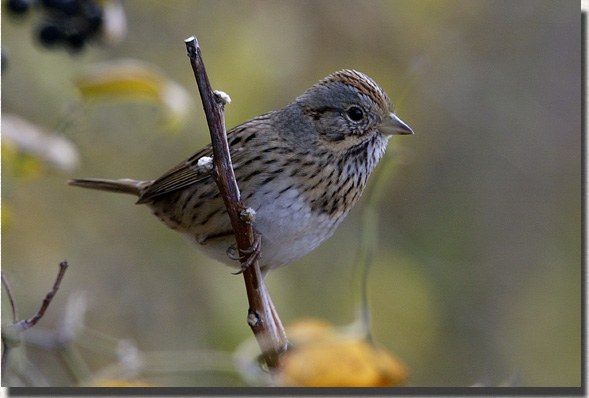
Lincoln's Sparrow
- Habitat
- Dense shrubby thickets near water on breeding grounds, brushy cover more broadly during migration and winter
- Size
- About 5.1-5.9 inches long
- Lifespan
- The oldest banded individual on record was at least 7 years, 11 months old, though most individuals likely live only two to five years
- Diet
- Seeds and insects
About the Lincoln's Sparrow
Lincoln's Sparrow is a subtly beautiful, often overlooked sparrow, with a finely streaked buffy breast band, a gray face with a thin eye ring, and a somewhat crested look to the crown when the bird is alert. Its patterning is more delicate and finely detailed than that of the similar Song Sparrow, though the two are sometimes confused at a glance; close comparison usually reveals the Lincoln's finer, crisper streaking, buffier overall wash across the breast, and grayer face, details that reward a patient, careful look at a bird that rarely sits still for long.
The species breeds in dense, shrubby wetland edges and boggy thickets across Canada, the northern United States, and higher-elevation mountain habitats farther south, well north or west of Oklahoma. During migration and winter, however, it is a regular though often secretive visitor to the state, favoring dense brushy cover, weedy field edges, and thickets where it can stay largely hidden from view. Spring migrants tend to pass through a bit later than many other sparrows, and fall migrants often linger into early winter, so the window for finding the species in Oklahoma stretches across a fairly broad stretch of the cooler months.
Its diet consists mainly of seeds and insects, gathered by foraging quietly on or near the ground within thick cover, a habit that, combined with its skulking nature, means the bird is often detected first by a sharp chip note rather than by sight. When flushed, it typically flies only a short distance before dropping back into cover, rather than flying far into the open the way some other sparrows will, reinforcing its reputation as a bird that would rather stay hidden than be seen.
Lincoln's Sparrow was named by John James Audubon after his traveling companion Thomas Lincoln, who collected the first specimen described to science, and the bird has retained a reputation ever since as one of the more retiring, easily overlooked sparrows in North America. Its song, though rarely heard outside the breeding range, is often described by birders as unusually rich and musical for a sparrow, a bubbling, wren-like series of notes quite different from the simpler songs of many related species. Because of its shy habits, close study of its migration timing and wintering habits has often relied heavily on banding data rather than casual observation, and banders often note that the species can be surprisingly common in a patch of brush that gave no outward sign of holding any birds at all.
Several recognized subspecies of Lincoln's Sparrow breed across different parts of North America, varying somewhat in overall coloration and size, and most birds passing through or wintering in Oklahoma originate from breeding populations well to the north or from higher-elevation mountain ranges in the western United States. Young birds typically do not breed until their first full spring after hatching, and because the species is so easily overlooked, citizen science reports and banding stations continue to add useful detail to what is known about its movements through the state, filling in gaps left by a bird that rarely calls attention to itself.
On the breeding grounds, females build a well-hidden cup nest directly on the ground, tucked into a hummock of sedge or moss at the base of a shrub, and typically raise their young without the elaborate cooperative arrangements seen in some other sparrows. Once fall approaches, Lincoln's Sparrows depart their nesting bogs and thickets on a broad front, moving mostly at night like many migratory sparrows, and individual birds may take somewhat different routes in different years depending on weather and food conditions encountered along the way, a flexibility that likely helps a species so dependent on scattered patches of dense brushy cover during migration and winter.
Frequently asked questions
Who is Lincoln's Sparrow named after?
It was named by John James Audubon after Thomas Lincoln, the companion who collected the first specimen.
Does Lincoln's Sparrow breed in Oklahoma?
No, it breeds in shrubby wetlands farther north or at higher elevations; Oklahoma sees it mainly during migration and winter.
Why is Lincoln's Sparrow often hard to spot?
It is a shy, skulking bird that stays low in dense brushy cover and is often noticed by its call before it is seen.
What does Lincoln's Sparrow's song sound like?
Birders often describe it as an unusually rich, bubbling, wren-like song for a sparrow.
When is the best time to look for Lincoln's Sparrow in Oklahoma?
During migration and winter, since it does not breed in the state; spring migrants tend to pass through later and fall birds can linger into early winter.
Where to find it
This species favors wetland habitat. See real Oklahoma locations on the Habitats map.